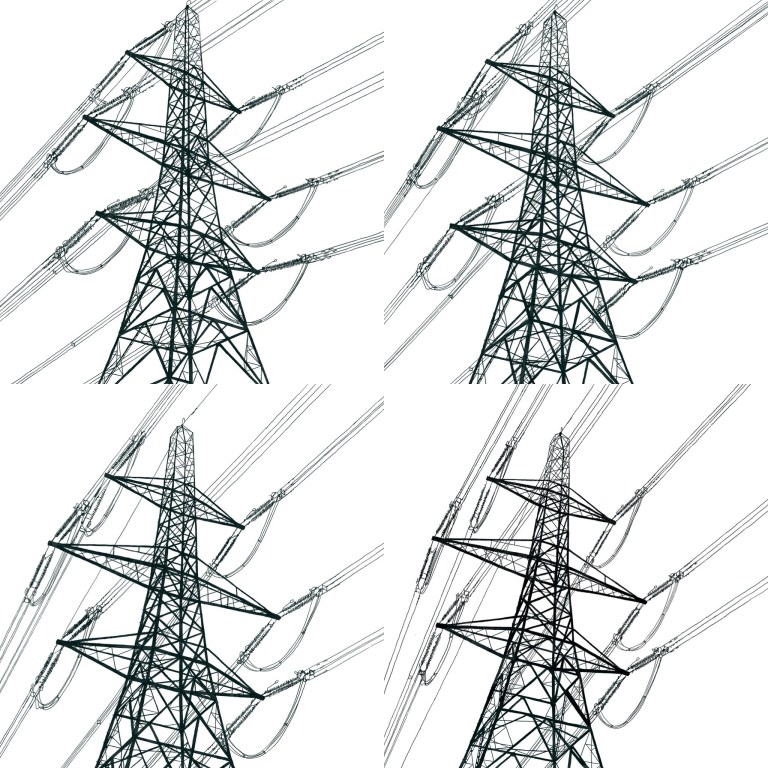
For the Watermarks project, I created 4 sketches of a pylon situated on the banks of the Aire and Calder Navigation near Birkwood Lock. The sketches were from footage I took whilst traveling on a barge. I wanted to capture the apparent gentle rotation of the Pylon in relation to my position as I sailed past.


A few words bout Pylons –
The 1926 Electricity Act created a government body called the Central Electricity Board (CEB), tasked with creating the UK’s first synchronised, nationwide AC grid. The grid would mostly use overhead cables to link the most efficient power stations in the country. These cables would be carried by transmission towers. In 1927, the CEB ran a competition to design the pylons. Sir Reginald Blomfield was tasked with choosing the winning design and adopted a design submitted by the American firm Milliken Brothers for the “grid towers” that would criss-cross the country. A staunch anti-modernist – as he made clear in Modernismus, his attack on modern architecture – Blomfield looked to ancient Egypt to name his steel towers. [1] In Egyptology, a pylon is a gateway with two monumental towers on either side of it. These represent two hills between which the sun rose and set, with rituals to the sun god Ra often carried out on the structure.

 Tony Wade