
On January 1st 2024 I found myself listening to the first LP by artist Frank Zappa. Having done so, I realised I owned quite a lot of his recordings. Turns out I have bought everything he released during his lifetime. I wondered what it would be like to listen to them all in order, and to write about the experience, each day. This turned out to be a very time consumimng and, at times, painful task because Frank Zappa made some of the best and worst records imaginable.
I posted these reviews on Facebook every evening for the next 58 days.
I’ve not corrected anything and have copied them from Facebook before they get lost in the algorithms of time, as I don’t want to do this again.
So… Day 1 of the Frank Zappa thing. June, 1966 Freak Out by The Mothers of Invention. (Having the month will become more important when some of these records will come thick and fast, literally and metaphorically – the Flo and Eddie years can be very thick).
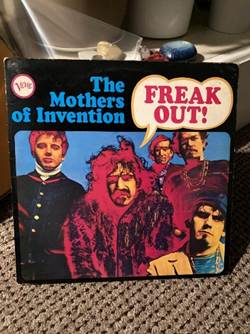
Some facts. The first double LP debut record. (Only the second double LP in rock music ever, arriving a few months after Bob Dylan’s Blonde On Blonde).
It cost a small fortune to record. (equivalent to $320,000 in todays money)
It sold not a lot.
It inspired Paul McCartney to called St Pepper “our Freak Out”
What’s it sound like?
Imagine a 60’s party where everyone starts off as friends, dumb dancing to slices of bubblegum pop. Occasionally someone puts on a Doo-wop record or a ballad but the lyrics don’t seem right….and paranoia kicks in and everyone starts peeking from behind the curtains in case the police turn up, and then things start to get a really odd. And now the pop songs don’t sound like they should, like they’ve been speeded up so the voices sound weird? It might be just me? Or maybe the record player is broken. Somehow the party isn’t fun anymore, and everyone is sulking because the music they are playing is now taking the piss out of them. Then the roof is pulled of the room and a truck full of percussion is dumped on everyone – for 12 minutes and 22 seconds.
It sounds like that.
Even if Frank Zappa never made another record his place in rock music history was assured. But he did. He made a lot more. Possibly 62 during his lifetime. And another 62 posthumously. FFS.
Day 2 of the Frank Zappa thing. May 1967. Absolutely free by The Mothers of Invention.
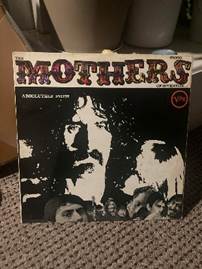
Somehow, despite Freak Out costing over a quarter of a million dollars (in today’s money) and only reaching 130 in the billboard charts, Frank Zappa got to make another record! (I blame the cigar chomping old guys).
Less conceptually dense than Freak Out, but more sonically adventurous, Absolutely Free is a pretty decent collection of songs and ideas, and is probably a lot more fun to listen to.
Mind you, it’s not your usual collection of songs, unless your usual collections include musicals inspired by a sartorial faux pas by President Lyndon B. Johnson (Brown Shoes Don’t Make It – which is also an argument that lawmakers tend to be morally corrupt and therefore the ones that shouldn’t be lawmakers, a point he continued to make throughout his career ) and the healthy contribution fruit and vegetables can have in keeping you regular (Call Any Vegetable & Duke of Punes).
Also, the riff from Louie Louie makes its first of many appearances.
With woodwind, keyboards and a second drummer added to the band, more musically adventurous compositions could be attempted and after a year of touring and playing live they could improvise more intricately than the competition (which, to be fair, there wasn’t any). And his guitar playing began to shine.
What does it sound like? Imagine living in a room between The Grateful Dead and the sound editor for Tom and Jerry cartoons but everything is twice as fast as it should be, so to hide the noise you put on the radio AND tv where adverts from hell are mixed with the painful birth of Sesame Street.
It made 41 in the Billboard 200.
Imagine that!
Day 3 of the Frank Zappa thing. March 1968. We’re Only in It for the Money – Mothers of Invention.
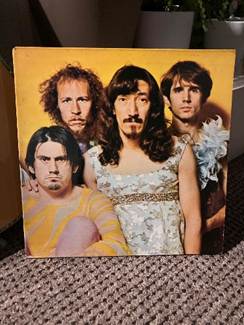
Zappa later said that he started recording this record simultaneously with the next three in March 1967 and that you can cut them all into differences pieces and randomly fit them together and they’d still make sense. This might actually be true because that’s exactly what they sound like.
This particular assemblage takes well aimed potshots at pretty much everything, from left wing and right wing politics (“prisoners of the same narrow-minded, superficial phoniness”) to hippies and psychedelia.
Even sacred cows such as The Beatles were in for a kicking, for selling out and being a part of the corporatization of youth culture.
And such is Frank Zappa’s ego that he had no problem in phoning up Paul McCartney to ask permission to rip off and parody Sgt. Pepper’s album cover (which had just come out at the time). Apparently he said he had no problem but it wasn’t up to him as the record label owned the rights to that (much to Frank Zappa’s surprise and disgust).
He asked the record label permission and, not surprisingly, they said no. The stalemate delayed the records release for a good 6 months. And it still sounded ahead of its time.
The long and the short of it is that on this record Frank Zappa took a close look at contemporary America and didn’t like what he saw (not surprisingly), even foretelling the Kent State Massacre (where the National Guard open fire on unarmed college students) 2 years before it happened. Whist others were being optimistic about the ‘60’s’, he saw only manipulation, corporate greed, STD’s and violence.
Using live band recordings, tape manipulation, orchestration, sound collage and everything he could lay his hands on, the resulting record is bitter, sad, funny (but in a very dark way) and ultimately strangely haunting.
What does it sound like? How about – the most important record of the 60’s.
Day 4 of the Frank Zappa thing. May 1968. Lumpy Gravy. Frank Zappa.
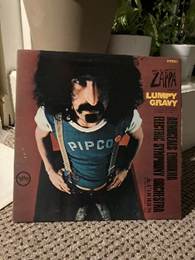
No Mothers of Invention this time (although some of the band did make appearances in vocal and musical sections). Just Frank Zappa and orchestra and tape recordings and band performances and spoken word and snatches of dialogue, all assembled into 2 sides of musique concrete.
Now, there are many reasons to dislike Frank Zappa and I’m sure I’ll get to some of those pretty soon, but one thing I do admire about this period is his rigorous and fearless explorations of contemporary classical music.
Whereas a few peers were very sniffy about it (‘avant-garde is French for bullshit’ – John Lennon) Frank Zappa had always embraced it. (Check out the YouTube clip of him playing a bicycle on the Steve Allen show in 1963).
What is remarkable about the orchestral pieces on this record is that he was a self taught composer and had been writing for orchestra for a few years by then. This was no passing fancy and an attempt at ‘grown up’ music. He meant it.
A bit of early history might be useful in tackling this record.
Frank Zappa was a big fan of the French composer Edgard Varèse (a composer who thought nothing of introducing a fire siren to an orchestra). So much so that for his 15th birthday present his mother bought him a long distance phone call with the composer (Varèse would have been 72 at the time – imagine listening to THAT conversation!).
He wrote and conducted avant-garde performance pieces for the school orchestra throughout high school.
His score for the film The World’s Greatest Sinner was recorded by the Pomona Valley Symphony Orchestra (a collection of amateur and semi-professional musicians) in 1961. (I have a record of it somewhere).
For Lumpy Gravy, Frank Zappa assembles an orchestra of classically trained musicians, many of whom were dismissive of Zappa as they saw him as a rock guitarist.
When he presented them with the score, which continued complex music in many time signatures, one of the musicians said the music was impossible and refused to play it. Frank Zappa replied “If I play your part, will you at least try it?” He played it on guitar. The orchestra then played their parts.
The timeline is also a bit slippery. (This will become increasingly so as he would stitch LPs together for different eras throughout his career, trying to create, what he would call, conceptual continuity).
The orchestral recordings date from 1966 but for contractual reasons weren’t released until 1968, with added tapes and stuff.
What does it sound like? Like the FBI surfing the American airwaves, capturing inconsequential conversations alongside paranoid plottings, surf music parties, jazz stations and contemporary classical broadcasts.
Not Easy Listening.
Day 5 of the Frank Zappa thing. December 1968. Cruising with Ruben & the Jets. Mother of Invention, though released under the alias of Ruben & the Jets.
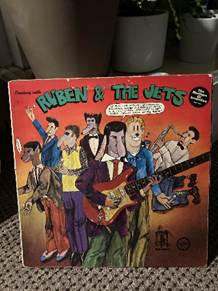
How to follow the complexities of the tape and orchestral extravagance that was Lumpy Gravy? Why, with a LP of original songs on a Doo-Wop style whilst pretending to be a different band, and one where the members were dogs. Obviously.
Handily Frank Zappa explained the record in small text on the inner sleeve.
“This is an album of greasy love songs & cretin simplicity. We made it because we really like this kind of music (just a bunch of old men with rock & roll clothes on sitting around the studio, mumbling about the good old days). Ten years from now you’ll be sitting around with your friends someplace doing the same thing if there’s anything left to sit on.”
Some songs were written for the album whilst 4 were re-recordings of tracks from Freak Out, all with authentic attention to detail (Motorhead Sherwood’s beautiful saxaphone solo on Anything) but with an unsettling twist (vocal recordings sped up, odd gurgling noises as backing vocals, just a bit too much slap back echo on the snare).
The record was a bit of a hit with radio stations, thinking they’d discovered an original Doo-Wop record, and was proof, should we need it, that Frank Zappa could write pop songs should he wish to.
I really like it.
What does it sound like? It sounds like Aliens, having picked up radio and tv broadcasts from 1955 in deep space, trying to assimilate themselves into 1968 America by posing as a rock band. And thinking Goofy might be a good look.
Day 6 of the Frank Zappa thing. April 1969. Uncle Meat. Mothers of Invention.
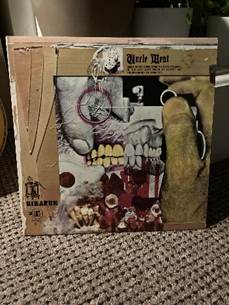
The compilation, Mothermania, was actually released a month before but I’m going to mess with the timeline (with my own bit of conceptual continuity) as Uncle Meat was the 4th recording in Frank Zappa’s No Commercial Potential project, alongside We’re Only in It for the Money, Lumpy Gravy and Cruising with Ruben & the Jets.
For many people Uncle Meat is his greatest work. Again, a mixture of orchestral pieces, freeform jazz, rock songs, spoken word, live recordings (the ridiculous and rather wonderful moment when Frank Zappa instructs Mother’s keyboard player, Don Preston, to clamber over the seating at the Royal Albert Hall to play Louie Louie on the venue’s gigantic pipe organ), and, of course, Doo-Wop.
Although he has previously stated that the music from all 4 of the records could be spliced any which way and still make sense I personally think he left the best till last. (The record is also the first time Ruth Komanoff/Underwood can be heard playing marimba and vibes, something she did on and off for the next 7 years, especially as part of what many think are Frank Zappa’s best years – 73 to 76). But I digress….
This double album contains some of his most loveliest tunes, ones that he would keep coming back to over the length of his career, and it’s no surprise that 3 of them feature in his final record issued during his lifetime, 1993’s Yellow Shark (which we might get to sometime in March….. FFS)
Uncle Meat, Dog Breath Variations (he had a way with titles), and Pound for a Brown on the Bus are highlights but it’s the final side long track ‘King Kong’ that remains its most memorable feature.
By this point this version of The Mothers of Invention could pretty much play anything Frank Zappa could and would throw at them, whilst improvising when they got a nod (or peculiar hand gesture) from their band leader.
What does it sound like? The finest tunes from pre war European avant-garde tango with Tom and Jerry whilst being trampled by Jazz from hell. Nice.
Day 7 of the Frank Zappa thing. March 1969. Mothermania – Mothers of Invention.
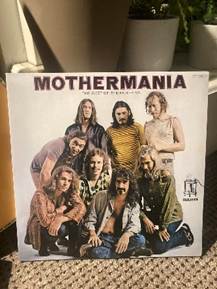
A compilation album released a month before Uncle Meat, but I’ve swapped the order around for continuity reason.
7 albums in 3 years. He’d start to speed up now.
Basically, a very subjective ‘Best of’ featuring remixed and slightly different versions of tracks for the first 3 records, put out by his old record label in an attempt to get some of their money back. (There would be a few more in the coming years which I won’t trouble anyone with, such as ‘The **** of the Mothers’, put out by previous record labels. Come on….there are enough records released by Frank Zappa during his lifetime and I’m only going to focus on them. Possibly)
Featuring an almost normal band photograph on the cover this is an enjoyable romp that must have been startling to anyone buying this at the time thinking a ‘best of’ might be an easy way in.
Frank Zappa would later disown the record when he found out it would be released one month before Uncle Meat, however he did an excellent job of crafting a record with its own identity.
It also acts as a bit of a pause because things get very strange from here on.
What does it sound like ? Excellent.
Day 8 of the Frank Zappa thing. October 1969. Hot Rats. Frank Zappa.
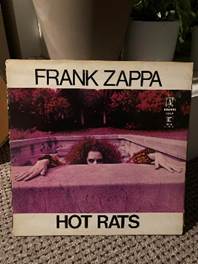
The Mothers of Invention were no more (though he would release two of the best Mothers of Invention Lps the following year) so this is the second Frank Zappa solo record (after Lumpy Gravy).
What is there to say about Hot Rats?
The one Frank Zappa record you can play at a dinner party? (Well, you can play others, but you wouldn’t necessarily be thanked for it).
The best record to give to a Frank Zappa novice?
It can be both those, but I feel that’s selling it short. It was a top 10 record in the UK and, apparently, it could be heard in every boutique, hip restaurant and happening throughout London in 1970.
What it is is a suite of 6 pieces recorded on a 16 track recorder (brand new technology at the time) which allowed for extensive overdubbing, many by the multi-instrumentalist Ian Underwood (piano, organ, flute, clarinet, saxophone) and Frank Zappa himself (guitar, percussion etc).
The musical styles successfully blend blues, jazz, classical and rock with none of the intentionally jarring edits Frank Zappa had previously used.
Tightly composed musical motifs morph into long (but never over-long) music jams with a succession of solos from Frank Zappa (guitar), Don “Sugarcane” Harris (violin), Jean-Luc Ponty (violin) and Ian Underwood (saxophone). Nice (Reference to Jazz Club is intentional).
What elevates these recordings above contemporary (though there weren’t many) jazz fusion recordings is the strong compositional hold Frank Zappa keeps on the music, embellished with percussion and woodwind overdubs to bring in ‘fanfares’ when needed.
Also, all this is nailed by the funkiest rhythm sections (Max Bennett on bass (Shuggie Otis on opening track Peaches en Regalia) and sometimes Paul Humphrey, sometimes John Guerin, on drums)
If you fancy listening to the 7 hours plus of Hot Rats Session you can hear various run through, try-outs, improvisations and head scratchings as various musicians try and grasp what is required from them, all the while being coaxed and coached by Frank Zappa, who is part Bill Evans and part Brian Wilson. (There’s a lovely piano piece that was recorded but not used at these sessions which does turn up on the next record as opening music for The Little House I Used To Live In).
5 are instrumentals and 1 has an extraordinary vocal contribution for Frank Zappa’s High School buddy Captain Beefheart (can you imagine that?).
Altogether now..
Hot meat, hot rats
Hot cats, hot zits
Hot roots, hot feet
Hot rats, hot cats
What does it sound like? Have a listen and tell ME what it sounds like.
Day 9 of the Frank Zappa thing. February n1970. Burnt Weeny Sandwich. Mother of Invention.
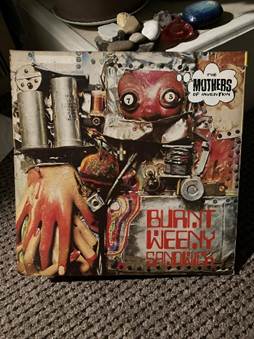
Even though Mothers of Invention were no more there was still plenty of recordings in the vault for Frank Zappa to play around with.
Often when bands split up there are unreleased tracks that get posthumously released in some form or another. These records usually confirm that the band was right to not release them in the first place.
What I find amazing about this record (and the one that followed) is that unreleased Mothers material was compiled into, arguably, the two greatest Mothers of Invention records ever.
I have to confess that this one is a personal favourite of mine.
Focussing on studio material and instrumental pieces, this record is a joy from start to finish.
The long song on side 2 (Little House I Used to Live In) could have come from Hot Rats, with its mixture of tight instrumental passages and extended solos.
‘Ivor’s Boogie, Phase 1 and 2’ are a heartfelt musical tribute to Igor Stravinsky.
‘WPLJ’ is a cover of a Doo-Woo favourite original by the Four Deuces
‘Holiday in Berlin, Full Blown’ is as good a composition as anything Frank Zappa would write.
What does it sound like? A celebration of the possibilities of music in the 60’s.
Day 10 of the Frank Zappa thing. August 1970. Weasel Ripped My Flesh. The Mothers of Invention.
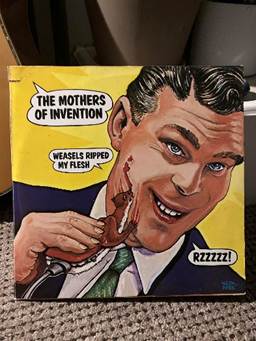
The second compilation of Mothers unreleased materials and again, one of Frank Zappa’s best records of the period (and best records ever, in my opinion)
It is housed in one of THE greatest record sleeves.
It also has some of Frank Zappa’s greatest titles –
‘The Eric Dolphy Memorial Barbecue’
‘Prelude to the Afternoon of a Sexually Aroused Gas Mask’
‘Toads of the Short Forest’
And of course ‘My Guitar Wants to Kill Your Mama’ (which is also his one song that should have been a huge hit).
Gentle tunes, noisy freak-outs, Dadaist vocalisations, again- it’s another compilation that holds together really well and brings the curtain down on the wild and crazy ride that was Frank Zappa in the 60’s.
It’s totally possible to just listen to these first 10 records and never have to listen to any others. Some would recommend you just do that, and I was tempted to stop there but that would mean missing out on some of the very best and very worst for Frank Zappa recordings.
Because when he was good he was very very good but when he was bad he was b*^%*+ks.
Anyway….what does this one sound like? A delicious mix between Andre Breton conducting Spike Jones and his City Slickers and the best garage band you’ve never heard in your life.
Day 11 of the Frank Zappa thing. October 1970. Chunga’s Revenge. Frank Zappa.
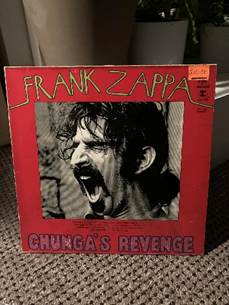
(I’m sticking with the Frank Zappa thing and pushing through to the 70’s. Tempting to take in other Zappa related releases but that would mean too many detours and actually having to listen to An Evenjng With Wild Man Fisher again).
Lots of extensive jams (Transylvanian Boogie, The Nancy and Mary Music, Chunga’s Revenge), which sound at times half arsed to me (apart from a blistering electric piano break from Ian Underwood), mix with ‘pop songs’ and (to quote Rudy Wants to Buy Yez a Drink) it’s Hi and Howdy Doody to THE PHLORESCENT LEECH AND EDDIE (vocalist Howard Kaylan and Mark Volman – formally of band The Turtles), who inhabit the next few records with their ‘unique’ brand of harmony vocals and theatrical comedy routines.
The instrumental Twenty Small Cigars sounds like an outtake from Hot Rats because that’s what it is.
And it’s alright. But reflecting on this record after having played the previous 10, it does seem a little light, a little throwaway? Sorry if it’s someone’s favourite but we can’t all like the same things. And he’s allowed a blip. It’s just that Frank Zappa’s marvellous sequencing and editing skills are not present.
Also, about this time Frank Zappa’s lyrical inspiration focus narrowed, leaving the broad scope of America society and politics alone to put ‘life on the road’ (and the sexually activities of his band) into the spotlight.
Now, there’s nothing wrong with that and around this time Robert Plant would be singing about having his ‘lemon squeezed until the juice ran down his leg’ on a nightly basis to thousands in arenas and stadiums across America. And earning a fortune whilst doing it. Maybe Frank Zappa wanted a bit of that.
Oh, and he gave the task of delivering these ditties to two over excitable stoners who think singing falsetto is the height of humour.
Anyway, at least with this record he’s get it out of his system. Right?
What does it sound like? Three completely different records – part Not Rats jams, part blue blues and part Bozo Bonzo’s.
Day 12 of the Frank Zappa thing. August 1971. Fillmore East – June 1971. The Mothers.
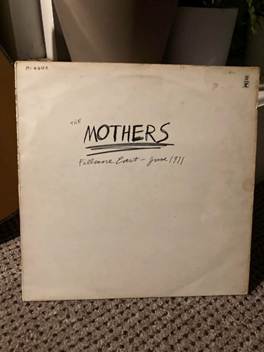
A live recording of the band formed around the time of Chunga’s Revenge.
This line up could play ferociously and fearlessly when pushed (nearly great versions of Little House I Used to Live In, Willie the Pimp and Peaches En Regalia).
I just don’t think they were pushed enough on this record because,…..let just say, following Day 11, Frank Zappa hadn’t got it out of his system.
The record is mainly a set of old and new songs loosely strung together around the telling of the legendary ‘Mud Shark’ incident at the Edgewater Inn in Seattle, involving rock band Vanilla Fudge, fishing equipment, an 8mm movie camera and a ‘friend’. etc
More of Frank Zappa’s anthropological explorations of the rock star/groupie interactions, which are very much of their time, with an audience lapping up the ‘risqué’ banter from Howard Kaylan and Mark Volman (observant readers may be getting the feeling that I’m not a fan of Howard Kaylan and Mark Volman).
There are better recordings of this band out there now.
(Check out Live at the Rainbow Theatre 71……the recording of final concert by this line-up, their first concert after their equipment got burnt down in the legendary fire in Montreux (all together now ‘We all came out to Montreux, On the Lake Geneva shoreline……’) and which documents why Frank Zappa had to give up touring for a couple of years. No spoilers).
Or check out Playground Psychotics – a mixture of live recordings and field recordings that give a better indication of life on the road (especially funny is the recording of when the band were met off the plane by a garbage truck which one over excited promoter had hired to pick up the band in, thinking it’d make a great photo and story. Frank Zappa was suitable unimpressed.)
I’ve just looked ahead and should I keep this up then I’ll finish in 41 days time. March 10th. It’s Mothers Day!
What does it sound like? A band, having played and played and played, letting off steam? (Whilst annoying kids are the background shouting “Me! Me! Me!)
Day 13 of the Frank Zappa thing. October 1971. 200 Motels. Frank Zappa.
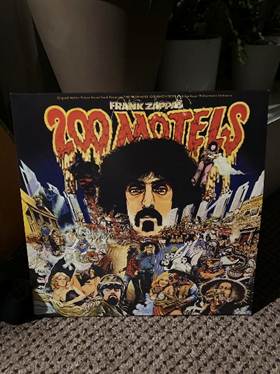
This record (a double) is the soundtrack to the film 200 Motels, a surreal comedy/documentary written by Frank Zappa. It’s a fictional account of life on the road (again) and what happens when the band arrives at ‘Centerville’ (a made up place).
It’s both one of his most famous records and also one that might be viewed as a one off (as it’s a soundtrack)
Orchestral pieces (performed by the Royal Philharmonic Orchestra, no less)that pay homage to Igor Stravinsky, rub shoulders (and other things) with rock songs (Mystery Roach rips off Whole Lotta Love (which ripped off…))
It’s a musical of sorts. With tortured vocals by Howard Kaylan and Mark Volman. Again.
For me, the orchestral pieces seem heavy handed at times and a bit lumpy. It might be that Frank Zappa really fancied scoring for a full orchestra but I think the music would have been better served by a smaller ensemble (I might be pining for his old band).
Having said all this I have to confess that this is the first time I’ve listened to this record in over 30 years (at least) and I’m enjoying quite a bit of it. The piano and percussion piece ‘Redneck Eats’ harks back previous years. Also, the less pompous pieces (Centerville, Dew On The Newts We Got etc) point to more palatable pastures.
It has George Duke on it (keys) and Ruth Underwood (percussion) so it does hint at what was to come, even though no one knew it at the time. (Magic Fingers sounds like a couple of years in the future)
So what we have is an extended suite of progressive operatic rock with orchestra. There was quite a bit of it about at the time and I guess my disappointment in this record is that, such was Frank Zappa’s talents, he didn’t wipe the floor with the competition.
Some excellent passages are trampled on by nonsensical lyrics. It’s almost as though Frank Zappa is embarrassed by his orchestral ambitions (something he was never worried about in the past).
To quote the track Dental Hygiene Dilemma –
[Bad Conscience:] Why are you wasting your life, night after night playing this comedy music?
A thought….. you can get lots and lots of Frank Zappa extended recordings. (I think you can buy over 7 hours of 200 Motels tracks) …how about releasing an edited version with less tracks on it (200 Motels -reduced)?
And maybe it’s failings are because, once more and not for the last time, Frank Zappa is creating musical pieces he’s not emotionally attached too; it’s an exercise in musical forms which I’m sure was of interest to him (and he executes them with panache (Strictly Genteel does try to bring things to a satisfactory conclusion)) but it’s leaves the listener having not really gone anywhere other than through a period of time.
What does it sound like? The Rite of Spring meets the trite and thin (tortured rhyme is intentional).
Day 14 of the Frank Zappa thing. March 1972. Just Another Band from L.A. The Mothers of Invention.
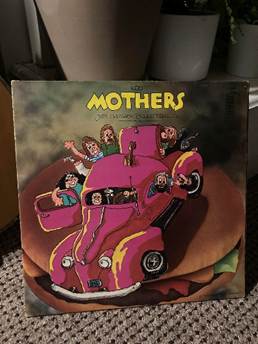
Another live one with same line up as the last one (day 12).
A 1972 release from a concert in August 1971, released for reasons that might become clear in the footnote.
Notable for the inclusion of the long song (all of side one) Billy the Mountain, which is about a talking mountain named Billy and his “lovely wife Ethel,” (“a tree growing off of his shoulder”) performed in the style of Peter and the Wolf, with musical motifs used to represent different characters.
A brief summary of the plot might help.
Billy (and his lovely wife Ethel) go on a vacation when they receive a royalty cheque from all the picture postcards taken of them nover the years.
Unfortunately their trip across America causes earthquakes and the accidental detonation of nuclear devises, bringing them to the attention of the US Government, who sends their special agent (Studebacher Hoch) to enlist Billy as they believe he will be of great service in the army.
Studebacher Hoch has a very special power which I won’t go into right now.
As a piece of Rock Opera parody it makes as much sense as Tommy. So there is that.
Once again Howard Kaylan and Mark Volman head up the singing/narration and it does sound like everyone involved is having a good time.
Side two is half new songs and half versions of previous tunes (including a souped up versions of Call Any Vegetable and Dog Breath).
Er..and that’s it really. Either it’s not as bad as I feared or the last few days have worn me down.
What does it sound like? Stooopid.
*Footnote* By this time Frank Zappa concerts had become chaotic affairs with lots of audience baiting as a well as banter. They also attracted what might be described as a crazier element. This tour culminated in a couple of catastrophes. Firstly all his equipment was destroyed when ‘some stupid with a flare gun’ burn down the venue he was playing in. Having borrowed new equipment, 6 days later, on 10th December 1971, he played the Rainbow Theatre in London. As the band encored with an irreverent version of The Beetles song I Want to Hold Your Hand an irate fan ran of staged and push Frank Zappa into the orchestra pit, where he suffered multiple injuries including a broken rib, fractured leg and a crashed larynx. The band thought he was dead. (Or course, he recorded it and the whole concert was posthumously released as Rainbow Theatre, December 10 1971, including the sickening thud as he hit the concrete floor of the orchestra pit and the ensuing chaos). This brings to an end the Howard Kaylan and Mark Volman years, well..year actually, and a year that saw 1 studio album, 2 live albums and a double album soundtrack. Frank Zappa might just need the rest.
Day 15 of the Frank Zappa thing. July 1972. Waka/Jawaka.
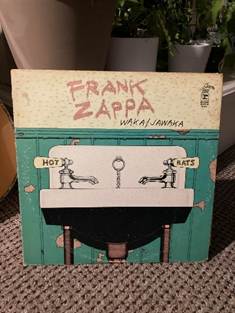
Released 7 months after Frank Zappa was seriously injured in an angry fan related incident (and it was very serious) this record sees him revisit Hot Rats territory. This time, however, he was accompanied by accomplished jazz musicians.
Like Hot Rats, this one features tight compositional elements as launch pads for free flowing improvised sections. And it all works a treat.
This, for me, is one of Frank Zappa’s most enjoyable listening experiences. It sounds relaxed. Maybe the break from touring (because he was confined to a wheel chair) was doing him some good.
Side 1 is dedicated to the track ‘Big Swifty’ featuring massed trumpet overdubs giving way to electronic piano solos from George Duke (always a pleasure).
Side 2 starts with the excellent big band vamp on Your Mouth followed by the slinky It Just Might Be a One-Shot Deal (with a beautiful slide guitar solo from Sneaky Pete Kleinow, a much in demand slide guitar player who’s cv is a who’s who of 70’s country rock royalty). Frank Zappa would normally play country music only to take the piss, here he’s crafted something quite beautiful. Interestingly he doesn’t sing much on this record, his crushed larynx might not have been up to it.
The final track Waka/Jawaka is beautiful and contains a stunning moog solo from long standing band member and collaborator Don Preston and a Zappa solo that confirmed his injuries hasn’t stopped him playing.
What does it sound like? Smooth and buttery muffins without the annoying utensils. Better than the previous 4 and a very satisfying listen from start to finish. Enjoy!
Day 16 of the Frank Zappa thing. November 1972. The Grand Wazoo. The Mothers.
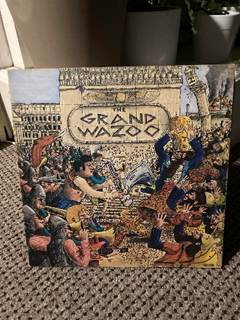
Still confined to a wheel chair and unable to tour, Frank Zappa embraced his inner big band arranger and arranged a number of compositions for big band. A very big band. (11 brass and woodwind players, 2 guitarists, 2 percussionists, bass, drums and the ever reliable Don Preston on Mini Moog, for the two tracks on side one).
A natural progression from Waka/Jawaka (and, therefore, Hot Rats) this is a thoroughly enjoyable slice of tunes, riffs, solos and ensemble playing.
And it swings!
Frank Zappa also starts to exercise his vocal cords again on Cletus Awreetus-Awrightus.
Eat That Question features one of those great rock riffs Frank Zappa was capable of coming up with in his sleep, and then it becomes a vehicle for a George Duke electronic piano solo (remember, these are always a good thing) and a lovely Frank Zappa guitar solo whilst the rhythm section have a ball. (Aynsley Dunbar was never a slouch on drums – being Frank Zappa’s drummer of choice on the previous 5 records. This, though, would be his last one as a main drummer. Recordings featuring him would keep cropping up in the next few, occasionally).
Final track, Blessed Relief, features more delicate solos over a relaxed groove (lovely trumpet solo from Sal Marquez) and more George Duke (who would become a vital band member over the next few records) and Frank Zappa at his most jazzy and restrained.
A delightful record.
What does it sound like? The Streets of San Francisco strolling in the sun and strutting their stuff whilst simultaneously dropping solos like stars.
Day 17 of the Frank Zappa thing. September 1973. Over-Nite Sensation. The Mothers.
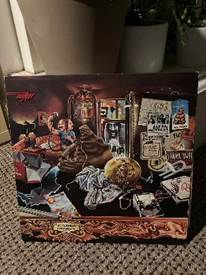
Previous records hadn’t exactly set the American charts alight (Waka/Jawaka reached number 157, Grand Wazoo didn’t break the top 200) so something happened to make this one of Frank Zappa’s most successful records (it made the dizzy heights of number 37).
There might be number of reasons for this.
The record is the start of a run of records containing Frank Zappa’s most popular AND complex compositions, especially with the fiendish Zomby Wolf, which flits effortlessly between rock and Anton Weber-ish Serialism.
There is also Montana, that extraordinary tale of a man who dreams of become in a dental floss tycoon, so moves to Montana. Obviously.
Or perhaps the kids in 1973 were big on the crazy and complex Fifty Fifty, which sounds like the Mahavishnu Orchestra on speed.
Or maybe it was the songs about sex.
Frank Zappa has a curious relationship with recordings about sex, or indeed recordings of sex (simulated).
A little history might be useful again.
In 1964 (when he was 24) Frank Zappa set up his first recording studio. One night he was approached by two undercover cops to record a ‘suggestive sounding’ tape for a fake stag party. He took on the commission and he and his girlfriend recoded ‘fake erotic episodes’. When he handed over the tapes he was arrested and charged with creating pornographic material, and was given a prison sentence. He served 10 day and lost his studio. I believe this made him both very untrusting of authority and fuelled an interest in what is morality, and the double standards that seemed to be at the heart of America.
So I think the ‘risqué’ Carmarillo Brillo and Dinah-Moe Humm got frat boys giddy. Whilst both songs lyrically attempt to achieve some climax, musical they go nowhere (Dirty Love works because it does sound dirty).
(Interesting aside – the backing vocals on this record were provided by Tina Turner and the Ikettes. Ike Turner, (ever the classy guy) insisted that Frank Zappa didn’t pay the singers more that 25 dollars per song (he didn’t want them having too much independent income). Frank Zappa paid them 25 dollars per hour (they did around 8 hours recording) so they had a good pay day. Ike Turner was outraged when heard the, frankly amazing, vocal section in the middle of Montana exclaiming “what is this shit?”, and insisted that they weren’t credited on the album).
There was a wealth of material available and recorded during these sessions and future Frank Zappa classics (Wonderful Wino, Inca Roads, RDNZL) were available.
That means Frank Zappa was astute in putting the ‘risqué’ songs on?
Or just lucky.
Anyway….the band he formed played magnificently on this and the next few records and would become, arguably, his most popular line-up.
What does it sound like? You are watching the best band you’ve ever heard whilst your mate’s older brother is talking in your ear about some made up sexual encounter he thinks you might find funny. Either that or it’s Carry On Emmanuelle does jazz prog?
Day 18 of the Frank Zappa thing. March 1974. Apostrophe (‘)
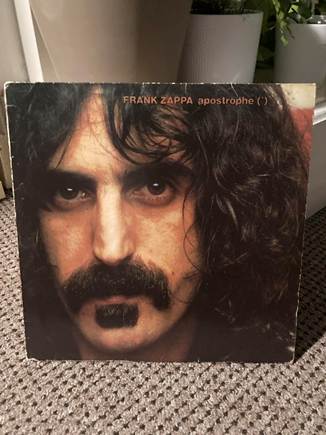
Officially Frank Zappa’s best selling record in America (Number 10 in the Billboards charts).
Side 1 is mainly given over to an extended piece that starts with Don’t Eat the Yellow Snow, Frank Zappa’s sensible advice to anyone trudging across the tundra.
And it works. Surprisingly. It’s one of Frank Zappa’s ‘comedy’ songs that is actually (and rather charmingly)funny, mainly because it sounds like he’s enjoying himself whilst telling the story.
It morphs jarringly into St Alfonzo’s Pancake Breakfast, a fast and frantic band workout, but such is the charm of Don’t Eat The Yellow Snow you don’t mind. Side 1 ends with Cosmik Debris, which would be a concert regular to come.
Side 1 was recorded at the same time a Over-Nite Sensation with side two being pieces together from recording sessions ranging back to 1969 and Hot Rats.
Second track on side 2 – Apostrophe – is a curios beast (and very enjoyable) with no one quite sure what happened. What is sounds like (and is credited to) is a live jam between Frank Zappa on guitar, Jack Bruce on bass and Jim Gordon on drums. Jack Bruce has claimed it’s not him as he thought Frank Zappa’s music was “….pretty awful” and only contributed a strange noise at the beginning, played on the cello. Frank Zappa claims it is Jack Bruce but that he never liked it because he thought Jack Bruce’s playing was too loud and busy. No pleasing some folks. I think the track is great.
Next track, Uncle Remus (a co-write with George Duke) is a return to Frank Zappa’s social commentary agenda and has a straight forward song structure (might be George Duke’s influence) but is a lyrically rebuke for anyone wanting to abandon the civil rights protests for cash and fashion.
It ends on a Frank Zappa future favourite – Stink-Foot, another ‘comedy’ song that works because the band grooves and it all sounds like fun.
Such is Frank Zappa’s production, editing and mixing skills the record all sounds coherent, contemporary and complete.
It’s the record I’d recommend to anyone curious about Frank Zappa and who I wouldn’t want to scare away.
It’s also a personal favourite (you might have guessed that).
Oh…and by now he’d recovered sufficiently from his injuries to start playing live again, even though one leg was now shorter than the other (no idea about his feet).
What does it sound like? The perfect social gathering. You can laugh with it, you can dance to it, you can sing with it. “Any of the above or none of the above or any and all of the above in combination or in tandem …”
Day 19 of the Frank Zappa thing. September 1974. Roxy & Elsewhere. Frank Zappa/The Mothers.
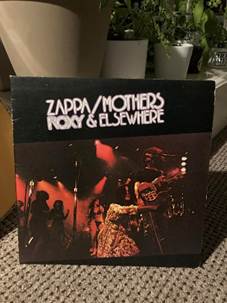
A double live album recorded in December 1973 at The Roxy Theatre, Hollywood and (elsewhere) Edinboro, Pensilvania and Chicago in May 1974. (The ‘elsewhere’tracks have no overdubs) with an 11 piece band (2 guitarists, 2 keyboard players, 2 drummers, bass, sax, trumpet, trombone and percussionist (3 backing vocalists were added later on the extraordinary track – Cheepnis, which is an ode to cheep sci fi films and contains a giant poodle named Frunobulax).
Featuring mostly new material (there is an excellent version of Trouble Every Day, called More Trouble Every Day, from his very first record) it’s an absolute blast and is often thought of as being his best record. It’s not but it has a lot going for it.
I have to confess I love most of it. Side 2 and 3 are full of wonderful moments of sublime music, frantic ensemble playing, astonishing solos and magical rhythmic coordinations between drummers Ralph Humphrey and Chester Thompson, and Ruth Underwood on percussion.
‘Don’t You Ever Wash That Thing’ contains the magic ingredients of ridiculously tight compositional elements and soloing over a great groove.
At this point the band could play anything and outplay anyone (though I have to say that a few months later, and with half this band, Frank Zappa reached, for me, a peak that can be heard on You Can’t Do That on Stage Anymore, Vol. 2, but as that wasn’t released until 1988 it can wait).
The thing that lets it down a little bit for me (but I think makes the record for many) are sections of sides 1 and 4 which contain lots of audience banter and the band goofing around (though side one’s Penguin in Bondage is great). As this was recorded for a film, (that didn’t see the light of day for a few years), maybe those sections make more sense in that context.
But they also do represent Frank Zappa pretty faithfully, wanting to communicate with the audience and also wanting to chat with his band and I also understand that talking was part of his art.
Side 4 is given over to “Be-Bop Tango (Of the Old Jazzmen’s Church)” which is, musically, very special. It does contains lots of audience participation but we’ve covered that.
It’s also a good example of future live records, where Frank Zappa would drill his band into playing new material, record it and release it as a new record. Because that is what it was. Live records were seldom ‘greatest hits’, more a snap shot of what he was creating at that time.
What does it sound like? Funny smelling jazz played by the best band in the best club with a band leader blathering long enough for you to get to the bog and then the bar for a beer. Which is nice.
Day 20 of the Frank Zappa thing. June 1975. One Size Fits All. Frank Zappa and the Mothers of Invention.
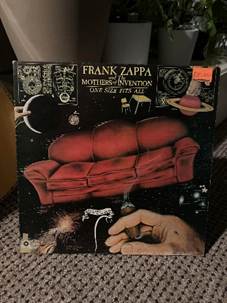
Featuring a stripped down version of the ‘Roxy’ band, this is a tasty mix of jazz and rock n roll that was successful and also good.
It contains many future live favourites including opening track ‘Inca Roads’, as complex as anything he’d done so far, yet it holds together due to the brilliance of the musicians involved. Solos fly in left, right and centre (and in the case of the guitar solo – fly in from a concert in Helsinki (I told you it was a good one)).
Sofa No. 1 is a slice of pomp that no one need be ashamed of loving.
Po-Jama People is an excuse for an extended guitar solo with excellent rock n roll piano from George Duke (who else), and why not.
Oddly enough ‘Florentine Pogen’ does sound like it comes from a future record (bigger rock riffs).
‘Evelyn, A Modified Dog’ is a brief barque ditty that can’t outstay its welcome as it’s only a minute long.
San Berdino is a wonderful country honk song that features one of Frank Zappa’s musical hero’s Johnny “Guitar” Watson (as well as one of his nemesis’ in Captain Beefheart – under the pseudonym ‘Bloodshot Rollin’ Red’.
‘Andy’ compliments Inca Roads in its complexity and the whole record rounds of nicely with Sofa No. 2, which is the tune of Sofa No. 1 with added lyrics, mostly in German, possibly describing things you might find in the cracks in your sofa (but don’t quote me on that).
It is a mish-mash of styles but it works rather well.
Sadly this excellent line up wouldn’t last. This was their last full record (though many recordings made by this band would appear in the next few records).
What does it sound like? Like a honky tonk, rinky dink, kitchen sink of a record by a band in the pink but sadly on the brink.
Day 21 of the Frank Zappa think. October 1975. Bongo Fury. Frank Zappa, Captain Beefheart and The Mothers.
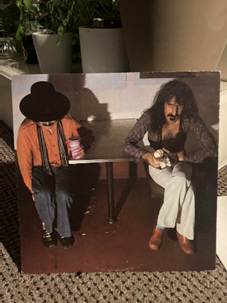
Part studio, with the ‘One Size Fits All’ band and part live, with the same band – minus drummer Chester Thompson but with the first appearance of drummer Terry Bozzio (who would stick around for the next few years).
But the big news is that old High School chum, Captain Beefheart, joins for most of the tracks and for the brief tour the live tracks were taken from.
Did they get on? Did they f%#+!
Frank Zappa says he felt sorry for Captain Beefheart as he’d lost all his money again in another poor business deal, so threw him a lifeline.
Captain Beefheart says he hated having to sing Frank Zappa’s dumb lyrics.
Luckily it both gave them the Blues because that’s what this record sounds like, for the most of it anyway.
Captain Beefheart gets a couple of writing credits for ‘Sam with the Showing Scalp Flat Top’ (a delightful piece of Captain Beefheart surreal monologue, accompanied by a bit of Louie Louie) and ‘Man with the Woman Head’.
However, anyone expecting Hot Mask Trout Rats would be very disappointed. It’s not bad, in fact it’s very enjoyable.
Studio track ‘200 Years Old’ is a great slow blues with excellent Beefheart growling vocals and growling harmonica.
The longest song is the live ‘Advance Romance’, a parody love song sung by long standing vocalist and sax player, Napoleon Murphy Brock, and George Duke (with Captain Beefheart relegated to harmonica, which seems a bit of a lost opportunity – although his harmonica solo is a snarling wonder). Lots of solos come and go, (including an excellent slide guitar solo by Denny Walley) and the song would be played live by just about every band line going forwards.
Definitely the most straight forwards ‘blues’ based record Frank Zappa would make.
Mind you, the record ends with Muffin Man – and song in two very distinct parts.
Part one is a cautionary monologue about what might happen in a lone baking environment with a selection of specialist equipment. This morphs into a live performance that brings the record to very satisfactory conclusion with a final (and frankly awesome) Frank Zappa guitar solo, an opportunity for us to hear the good Captain rhyme ‘Muffin’ with ‘Stuffin’ and (wonderfully) ‘Puffin’. followed by band introduction and a “good night, Austin Texas, where ever you are!”.
What does it sound like? Slow and bulbous blues with blueberry Beefheart muffins.
Day 22 of the Frank Zappa thing. October 1976. Zoot Allures. Frank Zappa.
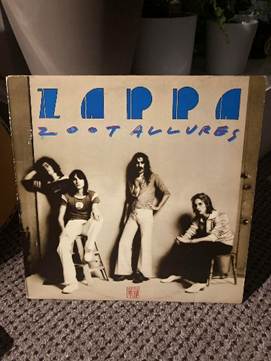
Released a whole years after his last one (the longest gap between record by a mile! – so far) this record is a mixture of new studio material, live recordings and tarted up tracks going back to 1972 (Wonderful Wino).
Members of his previous bands do make guest appearances but this record mainly features Terry Bozzio on drums with Frank Zappa playing everything else. (The record sleeve depicts Zappa and Bozzio along side bass player Patrick O’Hearn and keyboard player Eddie Jobson who don’t feature on this record but do on the next (I know, it gets very confusing.)
Three tracks (Zoot Allures, The Torture Never Stops and Black Napkins), would become regular live favourites.
Anyway….first track, Wind Up Working in a Gas Station, is the start of a new Frank Zappa sound – rock guitars and speeded up high pitch harmony vocals. There will be lots of those to come over the next few studio albums.
Black Napkins is basically an intro tune that transitions into a lengthy Frank Zappa guitar solo, nothing wrong with that.
The Torture Never Stops is the first time (I think) Frank Zappa uses a close up microphone technique on his vocals to make every syllable and utterance crystal clear. It’s also a remarkable production with space, grace and impeccable timing. (Oh and a, possibly, erotic moaning vocalisation from someone uncredited but who is, possibly, Frank Zappa’s wife Gail)
With appearances by Captain Beefheart, Ruth Underwood, Roy Estrada (the original Mothers bass player), Napoleon Murphy Brock, Ian Underwood, Bruce Fowler (and quite a few others) there is a sense that he’s using up recordings from the previous few years and getting ready for a clean break (though such was his amassed archive of recordings there were still plenty left for tracks to be dotted over the next several records.)
Find Her Fine is a ditty of the future ilk whist next track ‘Friendly Little Finger’ contains recordings from different places and is an early instance of Frank Zappa using a technique he called Xenochrony, where recordings of instruments from one song are combined with recordings of different instruments from a completely different song (often playing in a different time signature and key). He’d do a lot of this in future.
Wino Man was originally recorded for Over-Nite Sensation and finally finds its place here.
Zoot Allures is an instrumental, and a beautiful one at that (big love to Dave Parlato for bass on this one. He features on and off over a number of recordings. A bit of research threw this up. – (Dave Parlato was a member of The Mothers Wazoo incarnation – tho’ did not appear on the recordings at that time. However, during the Petit tour, at one point (on a bus ride to the gig), Parlato noticed from the window at a stop a dog urinating in the snow; to which he responded “Don’t eat the yellow snow!”. According to Dave, “a few days later, Frank had turned it into a song”)
The records ends up with Disco Boy, an entry in Frank Zappa’s ever increasing portfolio of songs dismissing current musical trends because he never got a handle on them (remember, he couldn’t figure out The Beatles) Just wait until we get to his thoughts on Punk and New Wave (and Twisted Sister)
Over all …. One of Frank Zappa’s ‘mixed bag’ records, sometimes poignant, sometimes pretty, always polished and sometimes petty.
What does it sound like? A sublime to the ridiculous romp through his own back pages and crystal balls, looking backwards as well as forward to see if he has some future as well as a past whilst tastefully presenting a smorgasbord of tit bits for a dilettante’s buffet.
Day 23 of the Frank Zappa thing. Zappa in New York. March 1978. Frank Zappa.
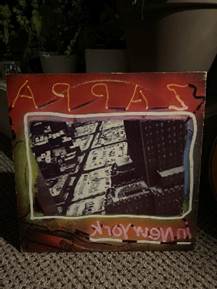
Wait, what! His last record came out in October 1976. Was he slacking?
Actually, no.
A little history might explain. These recordings were made during a series of concerts between Christmas and New Year 1976. This (a double record), alongside 3 other full LPs of new material were handed over to his record label in one go so he could get himself out of the contract.
Not unreasonably they refused.
This live record was then due for release in 1977, shelved, and then finally released in 1978. (Two of the other 3 AND 2 double albums AND another single album came out in 1979! – but let’s not get ahead of ourselves).
So – Zappa in New York – a double live album of mainly new material (of the old pieces, there is an excellent version on Sofa) featuring a 12 piece band (including a 5 piece brass section) with old and new members.
(I think some of the brass section was borrows from the Saturday Njght Live house band, augmented by the Brecker Brothers – if you can find it it’s worth checking out Saturday Night Live Episode Number: 34 Season Number: 2 for the band playing an awesome version of Peaches En Regalia)
Overall, and generally speaking, it’s a top notch mix of jazz, fusion, big band, experimental & fiendishly difficult music that contains one of my favourite Frank Zappa compositions (more of which, later).
How to commence this awesome record?
Why, with a track called Titties and Beer. Naturally.
Er…..ok…I’ll do my best. It’s a story song and cautionary tale about temptation, redemption, set in a fictional landscape with a small cast of characters recounting an unusual meeting of mixed personalities. Can I leave that there?
Good.
Next is a delightful and delicate instrumental, with a beautiful Moog solo from English keyboard player (and ex Roxy Music member) Eddie Jobson called….*checks notes* ‘I Promise Not to Come in Your Mouth’. (It doesn’t get any easier you know…..)
After a few more musical extravaganzas we get the ‘The Black Page’, which I think is a Frank Zappa peak.
Written initially as a piece of music for drums and given to Terry Bozzio to learn (which he did), it’s both ridiculously complex and rhythmically enjoyable. After Terry Bozzio mastered playing it (do check out this link which shows the score https://youtu.be/CyH8A_XPXeM?si=o69te5jXfI1KPWnR) Frank Zappa wrote a beautiful melody over the top. If that was not enough he got the band to play it again over a disco vamp (later Frank Zappa bands would be drilled into playing this highly complex piece over a reggae beat and an ambient jazz setting). It’s become a challenge that many jazz ensembles, especially in Europe, wanted to master in order to prove their credentials. But the original, and I think best, version is on this record (though it has been enhanced with percussion overdubs by three other percussionists).
Onwards…
‘Honey, Don’t You Want a Man Like Me?’ is another ‘story’ song over a backwards sounding vamp which starts and finishes (nothing more to add).
Then we have ‘The Illinois Enema Bandit’, based a true story and recounted by guitarist and singer Ray White as a slow blues. If you wonder when Frank Zappa was going to play a guitar solo then here it is.
The final side is given over to the track ‘The Purple Lagoon’ featuring rubbery bass from new guy Patrick O’Hearn, a stop start brass section that sound suspiciously like a previous composition called ‘Approximate’ (again, do go to YouTube and look Approximate up, it’s one of his “further out tunes”) and then we have a Mike Brecker tenor sax solo that is breathtaking and gets a well deserved round of applause. There’s the rare thing of a bass solo from Patrick O’Hearn before harmonised brass (which I think is Randy Brecker playing a trumpet through electronic treatments) bring the track home.
What does it sound like? Top Draw Jazz music and Top Shelf Jazz mag Zappa fight it out in furious, festive fandango of horns, harmony and hormones.
Day 24 of the Frank Zappa thing. September 1978. Studio Tan. Frank Zappa.
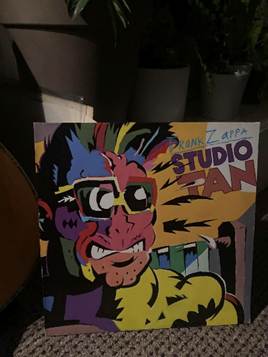
The first of three records containing music amassed by Frank Zappa over the previous few years, featuring many musicians from the ‘Roxy’ era band.
Side 1 is given over to the track ‘Greggery Peccary’, a musical, of sorts.
Complex music, referencing many previously explored themes and styles, form the bedrock for a ‘story’, narrated by Frank Zappa, and with the character ‘Greggery Peccary’ voiced in a speeded up ‘chip-monk’ style.
The story, such as it is, is an excuse for Frank Zappa to express some of his opinions on a favourite number of things that annoy him, including …..hippies, corporate America, hip young people, people following trends, people making trends, people taking drugs (basically he’s annoyed that people are not buying his records and he finds them stupid, except the people taking drugs as they DO buy his records but he finds them stupid anyway). Just when you start to think that Frank Zappa is just rewriting Billy The Mountain, Billy The Mountain makes an appearance.
There might be more to that plot but I’m not sure. (Oh, yes, and women who work in typing pools and stupid as well). It fades out, along with my interest.
Of course, it’s played impeccably (not surprising given the musicians involved) but it’s not as clever as he thinks it is.
Side 2 has three pieces on it and is something else all together.
It starts with the short and concise Let Me Take You to the Beech, a song first recorded at the time of Hot Rats and is a souped up Doo Wop mystery movie of a beach bum. It’s ace.
But the next track really is a gem.
Revised Music for Guitar & Low-Budget Orchestra starts with a beautiful duet with acoustic guitar and piano with drums joining in to add concise counterpoints. (It makes you wonder why Frank Zappa didn’t play acoustic guitar more often). Then, just when you think it might stray down lounge jazz territory and string quartet arrives to steer everything back in course. More acoustic guitars arrive and then clever piano, brass and percussion interactions signal the middle section. What we have here is the kind of great American music Frank Zappa was always threatening to make and here he is making it. Low-Budget Orchestra suits him. It’s, for me, one his most satisfying instrumental piece (or maybe I’m just pleased it’s not Greggery Peccary – there is that)
The record ends with REDUNZL (later to be called RDNZL on many future live versions) and, again, it’s great! And you wonder why it’s takes so long to be released, as the band features George Duke, Ruth Underwood and Chester Thompson so is contemporary with One Size Fits All (and was part of the live repertoire at that time).
One of Frank Zappa’s most satisfying tunes gives way to a series of solos from Frank Zappa and George Duke. (If you’ve ever wanted to hear George Duke flex his jazz piano muscles on a piano rather than a Fender Rhodes (though he’s always awesome on that instrument) then take your shoes and sock off and step right in).
What does it sound like? Like the 2005 UEFA Champions League final between AC Milan and Liverpool (but only if you are a Liverpool supporter). After a demoralising first half Frank Zappa finally shows up and you are grateful you didn’t bugger off to the pub at half time and stayed to see if a miracle might happen (this is a true story).
Day 25 of the Frank Zappa thing. January 1979. Sleep Dirt. Frank Zappa.
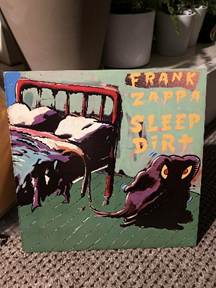
The first two side of 14 (fourteen!!) sides of vinyl Frank Zappa would release in 1979.
(A word of warning – this record, and others from around this time, would later be released on CD in the 80’s with added vocals and re-recorded drum tracks).
Another mixture of recordings from the last few years with a mixture of musicians to match (half ‘Roxy’ band and half ‘New York’ band)
Frank Zappa initially wanted to call this collection of instrumentals Hot Rats III.
Opening track ‘Filthy Habits’ is a heavy sounding slow mutated blues with arabesque passages for Frank Zappa to solo over (plus a bit of backwards phrasing for good measure) It sounds like if might take off…but doesn’t. It fades out instead.
‘Flambay’ starts life as a lounge jazz piano interlude but is joined by marimba, rubbery bass and drums, adding tantalisingly families themes. It’s as delightful as it might be throwaway.
It ends up sounding like a backing track wandering about in search of a tune.
It segues into Spiders of Destiny but you wouldn’t know it unless you looked at the grooves on the record. (Though the introduction of fuzzed guitar is a small clue). All in all, it’s a bit of Jazz Pomp that Todd Rundgren might have come up with.
It THEN becomes ‘Regyptian Strut’ (with Bruce Fowler on bass rather than Patrick O’Hearn, who played previously).
If they were all one piece it might make more sense though it does actually work, reached a pretty satisfactory musical crescendo thanks to big brass fanfares (by Bruce Fowler). I might have to listen to this again. (I’ve listened again. It’s great! )
Side 2 starts with ‘Time is Money’ which takes the pace from the end of side 1 and runs with it (basically, it’s the One Size Fits All band playing a style of music that will be familiar to anyone who knows Brand X or Return to Forever).
‘Sleep Dirt’ has Frank Zappa fulfilling my wish that he would play more acoustic guitar. It’s a beautiful acoustic guitar duet between Frank Zappa and James Youman. It ends with the guitar faltering and Zappa asks, “you getting tired?”; “no, my fingers got stuck” replies James. An oddly lovely moment.
The records ends with ‘The Ocean Is the Ultimate Solution’
Hurrah! More Frank Zappa on acoustic guitar.
It is a very satisfying piece of music with various musicians taking centre stage to deliver a solo (Patrick O’Hearn’s bass break is a joy, as is Frank Zappa’s guitar solo).
This definitely is Frank Zappa’s Jazz Rock record and the band could outplay anyone. Sadly I don’t think this kind of music would bring in big money and Frank Zappa needed big money to satisfy his musical and technical ambitions and he would very, very soon (in two months time – or tomorrow, depending on where we are) drift off into more contentious territories, which would bring in the cash, fame and a bigger platform but…..that’s for tomorrow.
All this makes you wish the Warner Brothers had released all these recordings (Frank Zappa in New York, Studio Tan, Sleep Dirt and Orchestral Favourites) when Frank Zappas delivered them as a 4 record box set. He finally got his wish with the posthumous release of Läther
Over all it’s a very enjoyable slice of Frank Zappa.
And so ends Frank Zappa’s second age.
What does it sound like? A band happily dancing on the edge of ambition and oblivion, gloriously unaware that their leader was longing for lustier shores and adoring hordes.
‘
Day 26 of the Frank Zappa thing. March 1979. Sheik Yerbouti. Frank Zappa.
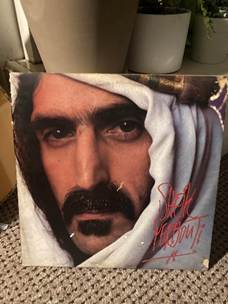
With the last couple of records Frank Zappa was able to free himself from his current record contract and set up his own label, Zappa Records, which meant he could record and release what he wanted to, without the pesky record company saying no.
He formed a new band around his current rhythm section of Bozzio and O’Hearn (which, put like that, sounds like a music hall act) and we say hello to keyboard player Tommy Mars, percussionist Ed Mann and guitarist Adrian Belew, amongst others.
The backing tracks are recorded live with extensive overdubs added.
Ok, we need to talk about Sheik Yerbouti, Frank Zappa’s best selling record (over 2 million copies sold).
This record, more than any other, has cemented his reputation, in many people’s minds, as being a sexist, misogynistic and homophobic bore and his output nothing more that the musical embodiment of a lads night out (the ‘lads’ being beer fuelled, noisy, horny and stupid) and songs about sex.
And there is no smoke without fire, because a lot of the songs on this record are just that.
Now, it can be argued that he was just creating songs reflecting a certain demographic and to paraphrase his own words “Unlike the unicorn, such creatures do exist—and deserve to be ‘commemorated’ with their own special opus”, but I don’t buy that.
An argument might be that ‘rock and roll’ and ‘jazz’ has always been about sex (the very names originated as slang expressions for sex) and all Frank Zappa was doing was being honest, and writing songs about sex as truthfully as he could, without masking it in poetry, coy innuendo and flirtatious flippancy.
In his head he was saying “look, people, you are being sold a lot of hysterical nonsense, that wraps up the act of sex in so much time wasting embellishments, why not buy my version which gets straight to the point?”
The problem is, the poetry, embellishments, and all the rest, are what makes songs about sex interesting and with Frank Zappa’s version you get nothing more than a very brief description over a 4 to the floor rock beat, and is that really what you want? (And it’s ok if you do, by the way. This line of thought is mine alone and other lines of thought are equally valid).
Also, by this time Frank Zappa had cocooned himself, through relentless recording sessions and tours, and dived head, feet (and everything else) first into the seedier side of the life as a rock star (though no drugs….apart from nicotine and caffeine, and what harm would they do him?).
It turns out the sexist, misogynistic, homophonic, beer fuelled, noisy, horny and stupid person Frank Zappa was appealing to was Frank Zappa himself but, as he’d discovered a few years earlier, sex sells.
Frank Zappa would later say ‘every time a song like Bobby Brown became a number 1 hit in Finland I could afford another day with the London Philharmonic Orchestra’. What price art.
Unfortunately for Frank Zappa, the more he released material like Bobby Brown, the less likely it would be that the people his orchestral works were aimed at would actually go out of their way to hear them. He despised that audience anyway so this moral conundrum would continue to play out for the rest of his career.
And in the end I believe it would be his undoing, trying to play serious compositions to audiences that just wanted songs about ‘titties and beer’.
Anyway….as the saying goes, let’s ignore the bad and reward the good (which means I won’t dwell further on I Have Been In You, Broken Hearts are for Assholes, I’m So Cute, Jones Crusher, Bobby Brown, Baby Snakes, Jewish Princess, (this sounds like that part in the film Clerks, where Randal is ordering porn videos in front of the mother and daughter) and quite a few others, other than to say they are very catchy and Frank Zappa did have a way with riffs and tunes which could have made him a small fortune if he’d only embellished the lyrics with *checks notes agajn* ‘poetry, coy innuendo and flirtatious flippancy’. The irony.
What we have left are the reasons why I still play this record a lot. ‘Flakes’ (dedicated to lazy workmen) has terrific riffs, an bonza Bob Dylan impersonation and builds to a bonkers climax, ‘City of Tiny Lights’ has musical muscle, dynamic performances and a great vocal from Adrian Belew, ‘Rat Tomago’, ‘The Sheik Yerbouti Tango’ and ‘Rubber Shirt’ are both enjoyable instrumental montages of different performances from different times, places and music. Dancing Fool works because the object of Frank Zappa’s scorn might well be Frank Zappa himself (remember one leg was shorter than the other…)
And I like side 4 a lot. Yes ‘Wild Love’ is about sex but it’s dressed up in an outrageous amount of jazz, prog rock and stacked harmonises that it’s impossible not to be impressed, like the dullest story turned into the most towering opera. (It’s tempting to think that Frank Zappa was having a pop at all the English Progressive Rock bands (Tales of Pornographic Lotions, anyone?) that were doing very big business in the states at that time (who played sellout concerts in venues way bigger than Frank Zappa could ever fill) by playing music that outshone them all by miles, with added disco beat).
The album ends with Yo Mama. Here, the only things we are taking off are tight shoes as the band relaxes, stretches and plays slowly allowing Frank Zappa to perform an excellent extended guitar solo (though it was recorded at a different concert to the rest of the band) as the music builds to a synthesised symphonic crescendo, band introduction and ‘good night’.
What does it sound like? Like the sound in the head of a character at a razzle dazzle, boozed up frat party in a rock disco occasionally having a vague memory of something he thought he should be doing instead.
Day 27 of the Frank Zappa thing. May 1979. Orchestral Favourites. Frank Zappa.
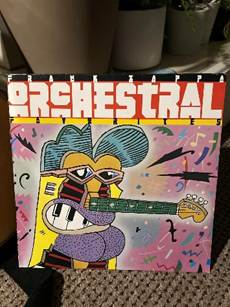
The final part of the bumper bundle of goodies Frank Zappa wanted his old record label to release as a box set (along with New York, Studio Tan and Sleep Dirt) is a recording of orchestral pieces from 1975.
It couldn’t be further away from Sheik Yerbouti if he tried (both in content and chart position – it made the dizzy heights of 168 in the Billboard charts compared with 21 for Sheik Yerbouti).
Some familiar titles and themes are performed by a 23 piece orchestra, playing alongside his regular band – including Terry Bozzio, Dave Parlato and Ian Underwood.
Mostly original material though Strictly Genteel was originally from 200 Motels and Duke of Prunes dates back to Absolutely Free (1967)
Frank Zappa claimed to have spent $200,000 of his own money doing this.
Was it worth it?
‘Strictly Genteel’ is a sedate romp through the original tune with slight variations on the main theme and is surprisingly unchallenging, but still way ahead of music produced by any other rock musician dabbling in orchestration at the time (there was a lot of it about).
‘Pedro’s Dowry’ is more like the Frank Zappa from the 60’s and is better for that. Strings and trombone slid satisfactorily around a melody whilst percussion hints at a dance, and rather wonderfully reminds me of the music from the first series of Star Track, where Kirk would be off his
head on an alien planet.
‘Naval Aviation in Art’ is a great title for a short piece of music constructed out of clusters of trumpet and violin phrases which is a brief as it is delicate.
Side 2 starts with a version of ‘Duke of Prunes’ and repeats the same trick as on Strictly Genteel. This time Frank Zappa has overdubbed a guitar solo.
The final track ‘Bogus Pomp’ contains a number of musical passages familiar to anyone familiar with 200 Motels (Frank Zappa might be more obsessed with that music than most of us). His love of Stravinsky is still strong on this piece. It’s lovingly constructed and the final passage with percussions and piano, with sliding violins, is particularly satisfying.
I think these are all successful pieces but they sold poorly. That’s probable why (remember these were recorded in 1975) Frank Zappa would not releases another record of orchestral music until 1983 and the ill fated sessions that gave birth to ‘London Symphony Orchestra’ and that’s 8 albums (and rather astonishingly 26 sides of vinyl) later!
Back to what sells then.
What does it sound like? An alternative universe where classical and contemporary music coexist as a mutant disco where we all dance to Captain Kirk’s delirium.
Day 28 of the Frank Zappa thing. September 1979. Joe’s Garage Act I. Frank Zappa.
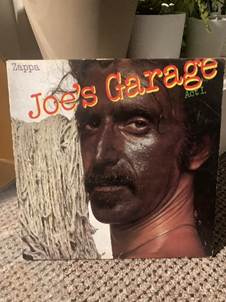
Joe’s Garage is a three act Rock Opera/Musical. Act I is a single album and Frank Zappa released Acts II & III as a double album a couple of months later.
I’ll try to summarise the plot of Act I (which is liberally sprinkled with a plethora of previously explored pastimes, pondering and physical acts – let’s see if we can spot them?!)
Joe forms a band that isn’t very good so gets arrested by the police who advise him to take up church related activities which leads him to fall for a nice Catholic girl called Mary.
Mary becomes a groupie for a band called Toad-O, leaves the band in Miami, enters and wins a wet T-shirt competition to get enough money to go home. A friend of Joe’s writes to him, telling him about Mary’s behaviour. Heatbroken, Joe sleeps with a girl called Lucille and gets gonorrhoea. And that’s the end of Act I.
And because I just know you want to know what happens next….
Act II.
Joe falls in with Appliantology and discovers their leader ‘L Ron Hoover’ has fetishes about appliances. Joe goes to a club and falls in love with a sex robot called Sy Borg, which is an industrial vacuum cleaner covered in marital aids. Joe accidentally kills Sy with a ‘golden shower’. Joe is arrested and sent to jail where anal sex is the order of the day. (You still following this?)
He becomes withdrawn and dreams of imaginary guitar notes.
Shall we press on? Good.
Act III.
Joe is released from prison into a dystopian future where music is banned. He walks around in a daze still dreaming guitar notes when he is taunted by his neighbour for some reason (it might be the same neighbour who called the police in Act I). He has visions about Mary and dreams his last guitar notes. He sings about how he hates music journalists, sells his imaginary guitar and gets a good job in the Utility Muffin Research Laboratory putting icing rosettes on muffins.
So…..this can all be read in one of two ways. It could be a serious critique of corporate America, censorship, political and religious interference in art and the attack on free will.
Or…..it is a good excuse to write a lot of songs about sex. (This may not be related but Joe’s Garage Act I is Frank Zappa’s first number 1 album in Norway).
Musically it’s a mixture of Rock, Prog Blues, (a hitherto unexplored musical genre on the song ‘Why Does It Hurt When I Pee) disco and reggae (on the surprisingly tender Lucille Has Messed My Mind Up) but as I’ve outlined the plot for all three Acts today I’ll do the same for the music tomorrow when I’ve has a chance to listen to Act II &III (it’s been a while).
Oh, Vinnie Colaiuta takes over on drums from Terry Bozzio. That might be significant.
What doesn’t the plot sound like? It doesn’t sound like Ben Elton’s Bohemian Rhapsody, that’s for sure.
Day 29 of the Frank Zappa thing. November 1979. Joe’s Garage Acts II & III.
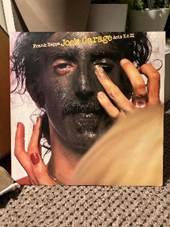
The second (and third) instalment of Frank Zappa’s Rock Opera/musical, that is either a) a serious critique of corporate America, censorship, political and religious interference in art and the attack on free will as well as a pretty accurate if gloomy glimpse into the future, or b) an excuse to write a lot of songs about sex (seen through Frank Zappa’s sometimes grim, sometimes disturbing lens on the subject) or is it both?
When he’s not writing songs about sex (and appliances and buckets of cold water and wet T shirts and ways of keeping things greasy) he can hit the mark.
Some of it is genuinely funny.
The title track Joe’s Garage is a heartfelt tribute to bands (good and bad) everywhere.
The track Sy Borg flirts successfully with reggae grooves whist the lyrics are in part a robotic soft porn tale involving vacuum cleaners…possibly. See, it’s all a bit like that.
You find yourself likening some of it and then….not. I think that the way he wanted it.
It actually sounds great and his band play tastefully.
Anyway….Frank Zappa acts as the narrator between songs in the guise of The Central Scrutiniser which sometimes explains what’s going on.
Generally speaking it’s very accomplished music (Keep It Greasy evolves into an frantic musical jam driven by Vinnie Colaiuta playing 19/16 time (a performance that earned him the title of “the most technically advanced drummer ever” in Modern Drummer publication)) with lots of guitar parts overdubbed using Xenochrony, a technique developed by Frank Zappa where he would take a recording of a live guitar solo from one song and added it to another. On Joe’s Garage, three guitar solos from three live performances of City of Tiny Lights would be overdubbed onto three of the album’s tracks.
I do like the xenochrony moments as I like Frank Zappa’s guitar playing, so that’s a bonus (though looking ahead there’s triple AND double albums coming up that feature only live recordings of Frank Zappa guitar solos (with band accompaniment) so those might test my patience a tad.
Having said that, one criticism level at Frank Zappa is that he is always emotionally detached from the music he creates; his pieces are musically complex and enjoyable but you never get a sense of the person or personality creating it. (Apart from some of the songs, where I believe you get a very good idea of what Frank Zappa really is like).
It’s in danger of fizzling out though so it’s a relief when ‘Packard Goose’ turns up and threatens to end the record on a high. That is then followed by the real high, when we finally get a glimpse of emotions we previously thought hidden. ‘Watermelon in Easter Hay’, an instrumental (and a celebrated on at that) features a beautiful guitar solo (the only one recorded for the record – as opposed to overdubbed from a previous recording) and the track feels like it has genuine emotional weight. Frank Zappa called it the finest song on the record. He’s not wrong.
Of course he couldn’t end this saga in such a way, so we end with ‘A Little Green Rosetta’, a song about icing muffins and with a big sing song from the whole cast (which, to be fair, is how you usually end a musical).
And there we have is. Joe’s Garage Acts I, II &III and the end of a, frankly, insane run of 5 albums (over 14 sides of vinyl) that was released in 1979. From the sublime to the ridiculous and a journey through the best and the worst that Frank Zappa could achieve. For some it’s the year he trashed his reputation, for others it’s the year he made it.
What does it sound like? I have no idea anymore but I’ll try. How about…Carry on Caligula creating masterpieces and monsters in equal measure, magnum opuses and onanistic pleasures go hand in hand whilst Frank Zappa aims to ice his muffin and eat it.
Day 30 (ffs) of the Frank Zappa thing. May 1981. Tinseltown Rebellion. Frank Zappa.
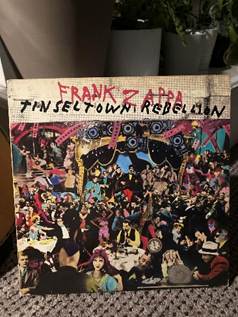
Released a whopping 18 months after Joe’s Garage, had Frank Zappa been lazy?
Apparently not. He’d been amassing a huge amount of material ready for a triple live album and a big album of studio recordings. These never got released in their original form. Instead they came out in 1981 as this record (Tinseltown Rebellion, a double album), 3 records of guitar solos collectively called Shut Up And Play Your Guitar and another double album called You Are What You Is (so that’s another 14 sides of vinyl in one year).
So…Tinseltown Rebellion is mostly a double live record. The exception being opening track ‘Fine Girl’ (a studio recording) and the following track, ‘East Meat’, which is stitched together from several live recordings and an overdubbed orchestral section played on synthesiser by Tommy Mars.
I’ve not heard this record for a while and I’m surprised by how much I like it. (Oh, and of course there are some cracking guitar solos on it as well).
Fine Girl is one of those songs that hints at an alternative career Frank Zappa could have has as a pop music writer, as it’s a killer track with memorable riffs, tunes and arrangement. Lyrically it guaranteed it wouldn’t bother the charts much. It’s not terrible (not by Frank Zappa’s standards) and much worse lyrics have graced the charts, but Frank Zappa’s reputation would always preceded him from now on.
The rest of the recordings are all live with no overdubs and demonstrate what a cracking band he had at that time. Most of the tracks were recorded at concerts between 1979 and 1980 with just Dance Contest coming from 1978 (more on that later).
Many of the songs are short in duration, with quite a few coming from the early part of his career (which was unusual as most live recordings were focused on new music).
‘I ain’t got no heart’ – Freak Out, ‘Tell Me You Love Me’ – Chunga’s Revenge, ‘Brown Shoes Don’t Make It’ – Absolutely Free and ‘Peaches En Regalia’ – Hot Rats.
The rest are new songs which only ever feature here, plus a couple of ‘audience participation’ sections. ‘Pantry Rap’ is a call-out for items of used female underwear to be made into a quilt (by American artist Emily James). ‘Dance Contest’ is a recording from 1978 and documents a moment where Frank Zappa is overwhelmed on stage by what sounds like drunk, over excited frat boys (remember them?) that his shows were attracting by then. The fact that he’s included it on this record must mean he places some importance on it as a historical anthropological artefact.
Two of the remaining songs once more highlight Frank Zappa’s missed opportunity is a hit record writer and are frustrating when they fail.
‘Blue Light’ starts out fantastically, with an outrageous riff that you want to go on forever but which sadly dissolves all to soon into a new vocal style Frank Zappa was developing at the time (and which would reach peak annoyance a few records later on Man From Utopia), where he delivers a half singing/half talking narrative (a bit like the operatic Sprechgesang). The object of Frank Zappa’s annoyance is, once more, hippies, drugs, conspiracy theories and Donovan. Possibly.
‘Tinsel Town Rebellion’ explores a now familiar theme – Punk Bands that sell their soul by pretending they can’t play just to get a record contract (one of Frank Zappa’s bitter sounding rants).
‘Pick Me I’m Clean’ opening section is another pop music wonder in waiting (He could also have made another fortune from producing other acts).
Which highlights the conundrum Frank Zappa found himself faced with.
He wanted to write serious music.
People don’t want to buy his serious music.
He wrote ‘comedy songs’ and ‘risqué’ songs as he justified their money making potential.
He never picked up on the much more lucrative options.
Anyway….
The final side has popular live track ‘Bamboozled By Love’ (which I think was first recorded around the time of One Size Fits All – and features an excellent slide guitar solo from Denny Walley, a guitarist Frank Zappa had known since 1955 and who first played with him on Bongo Fury) followed by a revisit to ‘Brown Shoes Don’t Make It’ with the big finale of ‘Peaches en Regalia’.
What does it sound like? It sounds like a bold and brassy blast through bits and bobs about bouncing bits and buns.
Day 31 of the Frank Zappa thing. May 1981. Shut Up ‘n’ Play Yer Guitar, Shut Up ‘n’ Play Yer Guitar Some More and Return of the Son of Shut Up ‘n Play Yer Guitar. Frank Zappa.
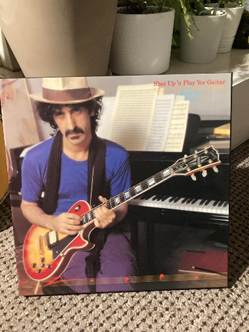
First released as mail order single albums (these eventually got released again in 1982 as a triple album box set), what we have here are three albums of Frank Zappa guitar solos recorded live between 1972 and 1980.
A preposterous proposition.
1 hour, 48 minutes and 8 seconds of guitar solos.
Some are solos from songs (for example, 4 of them come from live renditions of ‘Inca Roads’), some only exist as themselves.
What do you want to know? They are guitar solos. There’s 20 of them.
Ok….highlights.
First up is ‘five-five-FIVE’, a frantic number featuring the mathematical drumming skills of Vinnie Colaiuta. The time signature (I believe) is a repeated sequence of 5/8 + 5/8 + 5/4.
‘Hog Heaven’ is taken from ‘Easy Meat’ (all the solos from songs have their own names, just to confuse things further – I’m guessing Frank Zappa wants us to hear them as unique entities) and is a trademark loud Frank Zappa guitar solo over a slippery rhythm section.
Then we have ‘Shut Up ‘n’ Play Yer Guitar’ (the first of the 4 from ‘Inca Roads’) with side one ending on ‘While You Were Out’, which starts off with a gentle, clean sounding guitar, with notes played in a chordal fashion, before falling into more linear lines.
I’m not going to go through every solo, just personal highlights from now on.
‘Treacherous Cretins’ is a solo over a lovely dub reggae vamp (with Warren Cuccurullo adding an electric sitar arpeggio overdub).
‘Variations on the Carlos Santana Secret Chord Progression’ is an enjoyable solo from ‘City of Tiny Lights’ (and an enjoyable title as well)
‘Ship Ahoy’ is a rare funk outing (with what sounds like a ring modulator effect on the guitar) and is from a 1976 version on ‘Zoot Allures’.
‘Pink Napkins’ (from a version of ‘Black Napkins’) is a gentle, highly phased, solo that bubbles and gurgles like a mountain stream (ok….I’ve listening to these now for over an hour).
‘Why Johnny Can’t Read’ is from an 1979 performance of ‘Pound for a Brown’ and is a good example of Frank Zappa’s free flowing style, roving happily over chords, keys, tempos and common sense as he follows his nose and expects the band to know exactly what he is doing and play the correct accompaniment at the same time as he comes up with it.
This selection ends with the only studio track on the record.
‘Canard du Jour’ is a 1972 duet between Frank Zappa on Bouzouki and Jean-Luc Ponty on baritone violin and it’s lovely, and unlike anything else in the Frank Zappa discography.
It’s a fascinating way to end this somewhat overwhelming slab of sound.
What does it sound like? Really? It sounds like lots and lots of Frank Zappa guitar solos. Or for those wanting a more poetic appraisal …. Twenty tought and tenacious linear extrapolations along a nodal network of possibilities with each single progression starting a new chain of events that follow an internal logic we can only guess at. Or as Frank Zappa might put it, “The disgusting stink of a too-loud electric guitar; now that’s my idea of a good time”.
Day 32 of the Frank Zappa thing. September 1981. You Are What You Is. Frank Zappa.
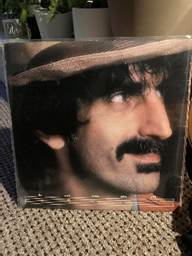
Day 32!….
Another double album, this time it’s all studio material that form three musical suites. (The first two are sides one and two of the record with the third suite taking up sides three and four).
Although ‘suites’ is a grand title, what we actually have are loads of individual songs that flow into each other to make three continuous pieces of music that are thematically linked (so I guess ‘suite’ is the right word.
A dizzying amount of styles are cover across this record (Doo-wop, Soul, Rock, Country, Reggae, blues, New Wave, Gospel, blues) which Frank Zappa manages to pull off convincingly.
Previous attempts have sounded like weak parodies but here he gets the nuances just right (to the extent that country song ‘Harder Than Your Husband’ (I know, I know….) went on to become a popular comedy country classic with many country artists covering it.
The joyful reggae bouncy meant that ‘Goblin Girl’ went on to be come a Halloween staple on American radio for years to come (until someone twigged that it might not be hobgoblin related).
I’ve been moaning about Frank Zappa’s unused pop skills for a while now and on this record he lets them loose.
There was even a video made for the single ‘You Are What You Is’ (which got banned because it featured a Ronald Reagan lookalike in an electric chair).
Generally speaking the album has Frank Zappa satirising a number of topics, including hippies, fashion, socialites, cultural appropriation, religion, tv evangelists and the draft.
If there is an overarching theme then the title sums it up – be yourself and don’t let others tell you what to do.
Oh, and there’s still room for one of Frank Zappa’s more fiendish composition ‘Theme from the 3rd Movement of Sinister Footwear’. (If you are curious do check out a cover of this by The Abington Auxiliary Armpit Trio)
The album is full of excellent harmony vocals, sharp playing and a general sense of fun! (The album cover even features a photograph of Frank Zappa smiling!).
It’s not all fun a frolics and ‘Jumbo Go Away’ is as nasty as Frank Zappa could get.
But the rest is genuinely funny, thoroughly enjoyable and I have to say I was taken totally by surprised by it.
Take, for example, ‘If Only She Woulda’, a delightful ‘best song The Doors never wrote’, where everyone gets it right rather than showing off. The keyboards by Tommy Mars beautifully mimic Ray Manzarek in tone and style whist shimming off into a nice psychedelic haze when necessary, and Frank Zappa delivers a fine solo in the middle section. The vocals are crisp and snappy, and secret weapon, drummer David Logeman, underpins it all with the appropriate rhythm. I think this is the only record David Logeman plays on fully and his playing is key to this record working so well. After the technical bravado of both Terry Bozzio and Vinnie Colaiuta, David Logeman just plays the songs, a simple skill the previous drummers weren’t encouraged to do. (We would be back to normal with the next drummer, the wonderfully appropriate named Chad Wackerman).
Do be aware though, later editions of this record were digitally remaster by Frank Zappa which strips them of this lovely warm analogue sound and makes them sound, to my ears, a bit harsh.
What does it sound like? A fun night with FM radio, broadcasting cautionary broadsides about your neighbours.
Day 33 of the Frank Zappa thing. May 1982. Ship Arriving Too Late to Save a Drowning Witch. Frank Zappa.
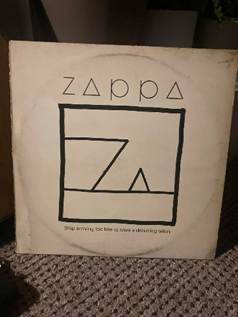
Half recorded in the studio and half live tracks from various times and locations stitched together with studio overdubs, this record features musicians from across Frank Zappa’s many musical phase joining his latest band for an, almost, New Wave outing (which is curious given how much he’d dismissed that music over the previous few records.
(I’ve not played this for over 20 years so it’s another voyage of re-discovery for me)
Opening song ‘On Not Now’ has original Mother’s bass player on falsetto and is a bright and bouncy pop song, of sorts.
Second track ‘’Valley Girl’ is the records most famous track. (It was released as a single and because Frank Zappa’s only US top 40 hit, reaching number 32) It was co-composed by Frank Zappa’s daughter Moon Unit. She wanted to spend some time with her dad so thought she’d better go to the studio, as that’s where he always was. Moon Unit’s vocal contributions were intended to satirise the San Fernando Valley teen culture, but instead it created a stereotype that became popular, with some of the songs lines becoming ingrained in the popular local vernacular. Now that’s ironic. Totally.
It also features the first contribution on bass by Scott Thunes, who would become Frank Zappa’s bass player of choice for the rest of Zappa’s career.
I Come From Nowhere starts out New Waveish but soon developers into a typical Frank Zappa live jam for the guitar solo (this part was recorded live with a previous band).
Side two starts with ‘Drowning Witch’, an ambitious long track that features a range of Frank Zappa styles, including his recently explored ‘scat singing’ (similar to that on The Blue Light), jazz phrases, spiky percussion passages, tributes to Stravinsky (there is a musical ‘nod’ to Rite of Spring) …. and is a welcome return of the ‘complex’ Zappa that had largely been absent on the last few records. (Frank Zappa would claim that it includes 15 edits from different live performances. Remarkably his band then learnt to play this as there is a terrific live version on ‘You Can’t Do That On Stage Anymore vol 3). It also has a ferocious Frank Zappa guitar solo and, all in all, is one of his more satisfying later period long pieces and would have baffled the hell out of anyone who bought this record on the strength of liking the Valley Girl single.
The arrival of a guitar riff announces that the track has morphed into the next track ‘Envelopes’, a piece originally written in 1968.
That track then becomes ‘Teen-age Prostitute’, a frantic romp with high, almost operatic vocal by Lisa Popeil, making side 2 one continues piece of music.
Well…..I liked that. A surprising return to, at times, vintage Frank Zappa but with a box fresh sound. I wasn’t expecting that at all.
The album would reach number 23 on the US charts which is quite something considering the experimental nature of most of the music (the power of a hit record).
What does it sound like? Well BARF ME OUT…and Gag me with a spoon! It sounds like teen-age America, amped up, ramped up and vamped up, ready to get down with their bad self and party with some pointy-headed music. Oh ma Gawwwd!
Day 34 of the Frank Zappa thing. March 1983. Man From Utopia. Frank Zappa.
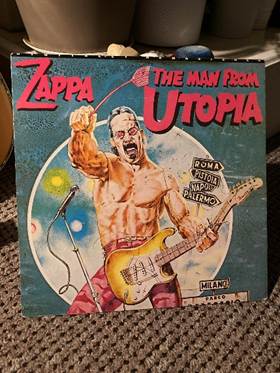
It starts off promisingly with ‘Cocaine Decisions’, a gentle skiffle type groove underpinning a Frank Zappa anti drug song.
However … the next song, ‘Dangerious Kitchen’, is the first of three songs that feature that new Frank Zappa vocal habit of talk/singing in a tortured ‘scat singing’ way. Interestingly though, poor guitarist Steve Vai had to transcribe Frank Zappas improvised vocal line and then play it on guitar. Quite a feat, but possibly proof that even though something is technically difficult it doesn’t mean it’s actually interesting.
Next track ‘Tink Walks Amok’ is a pacy instrumental mainly featuring bass player Arthur Barrows (whose nickname at high school was Tink).
The Radio Is Broken is another tedious Scat singing song (the second one on this record), intersperse with fast guitar passages but doesn’t really go anywhere and takes a long time to do very little.
‘Moggio’ is a Frank Zappa instrumental that is bright and breezy and could have been on any of his 10 previously records. It has a good tune also.
‘The Man From Utopia Meets Mary Lou’ is a pretty satisfying slice of Rock and Roll (parts of it are a cover version).
‘Stick together’ is a slight and slightly Reggae sounding moan about unions, something he thinks that were once upon a good idea but mafia involvement ruined it.
‘Sex’ Is one of Frank Zappa’s least interesting songs on this topic.
‘Jazz Discharge Park Hats’ completes the trilogy of Scat singing/Sprechgesang with Frank Zappa playing to a gallery full of baying macho stupidity and revealing a little too much about life on the road with his band.
The record ends, rather surprisingly, with a saxophone driven instrumental called ‘We Are Not Alone’ with a simple tune and it sounds like the theme music to a bad American comedy soap opera, which is strangely apt considering what gone on before it.
All in all this record has the feel of an excuse to release songs and tunes from the past 3 years that didn’t make the cut, and whereas previous such compilations have yealded rich pickings (due to the quality of material and Frank Zappa’s ability to edit and sequence brilliantly), this just sounds throwaway.
It might be someone’s favourite but for me it’s his dullest and dumbest record to date.
What does it sound like? The party is nearly over and all that’s left to play is the music you’ve not played yet, (and there’s a reason you’ve not played it yet) and the only person left speaking is the last person you want to hear.
Day 35 of the Frank Zappa thing. March 1983 (again) Baby Snakes. Frank Zappa.
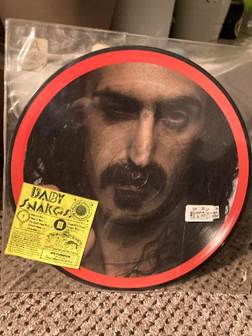
The soundtrack to a film of the ‘Sheik Yerbouti’ band playing live in 1977.
This record features 7 songs from the film focusing, mostly, on the risqué/comedy/ dumb songs (delete as appropriate), so we get ‘Titties and Beer’, ‘Dinah-Moe Humm’(played stupidly fast), ‘Jones Crusher Love’ etc.
We do, however, get an excellent version of The Black Page #2 which, almost, makes it worthwhile.
Everyone sounds like they are having a great time and the band is good so I guess your enjoyment of it depends on if these songs are for you or not.
The record ends with ‘Punky’s Whips’ a song that first appeared on some of the copies of Zappa In New York.
After a brief Terry Bozzio vocal performance (which, oddly enough predates Frank Zappa’s Scat Singing by some six years) about how Terry recently fell in love with a publicity photo of a boy named Punky Meadows, lead guitar player from a group called ANGEL, it settled down to a pretty effective platform (eventually) for a Frank Zappa guitar solo.
And that’s it.
What does it sound like? A rebooti of Sheik Yerbouti ?
Day 36 of the Frank Zappa thing. June 1983. London Symphony Orchestra Vol 1.
Frank Zappa.
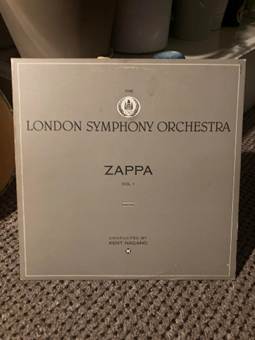
Frank Zappa’s second outing with a full symphony orchestra (this time conducted by Kent Nagano), recorded in January 1983, contains 4 pieces of music.
Frank Zappa has said that he found the whole experience frustrating, with the orchestra not properly learning the music or taking it seriously (perhaps they’d done their homework and just listened to ‘Jazz Discharge Party Hats’).
Of the 4 pieces, one, ‘Pedro’s Dowry’ had already been recorded by an orchestra (on Orchestral Favourites)
‘Envelopes ‘already existed as a band performance on ‘Ship Arriving Too Late to Save a Drowning Witch’.
The rest were new pieces.
So, with the hallowed London Symphony Orchestra at his disposal why did Frank Zappa have such a tough gig?
Culture clash might be one of them. Many of the orchestra’s principle players opted to not play at the sessions, their places being filled by less experienced musicians.
Frank Zappa treated the orchestra like his band, changing seating positions to suit some grand plan that only he had in order to make the orchestra better to record. (The performances were the first 24 track recordings of any orchestra which meant greater clarity and mixing possibilities but it also highlighted many mistakes)
Also, quite a few members of the orchestra took full advantage of the well stocked bar at the Barbican (where the performances were recorded) during their lunchtimes and would attend the afternoon rehearsals visibly drunk, not something that would impress Frank Zappa much.
He also thought he could tweak instruments and sounds as he went along, something that didn’t go down too well with the members of the orchestra.
Also…the music was very difficult to play.
Frank Zappa had an excellent ear and could hear all the mistakes and couldn’t quite believe that some of the musicians were happy with their performances.
Bearing all that in mind what we have left is the music.
‘Sad Jane’ starts with beautiful sedate passages that start to churn with greater complexity but remain a pastoral piece. In more detail –
Bars 1-2. The piece opens with the chord C-E-A-B, accompanied by a repeating harp figure in staff 6. The bass pedal A implies A Dorian.�- Bars 3-4. The bass pedal note switches to G#, thus the scale becomes an A Dorian variant with a major 7th, instead of a standard diatonic scale (A Dorian with a somewhat ambiguous leading tone). It makes the harmony more dissonant. In bar 6 the opening melody ends with G natural, thus normal A Dorian. (I looked it up).
‘Pedro’s Dowry’ is a slightly elongated version of the recording on Orchestral Favourites. More percussive elements are introduced and brass fanfares announce a series of thematics linked interludes. Regular drummer, Chad Wakerman, and percussionist Ed Mann provide more familiar textures.
‘Envelopes’ ends side one and whilst it is the shortest piece on the record it is a much slower rendition than the version on Ship Arriving Too Late to Save a Drowning Witch.
Side 2 contains one piece in three movements called ‘Mo ‘n Herb’s Vacation’ and is, I believe, Frank Zappa’s longest orchestral work in the atonal area. Clarinet takes the main melody at the start before strings take over. It is as startling as it is, at times, impenetrable.
Although Frank Zappa, as I’ve written before, was very critical of the performances and did a lot of tinkering afterwards to hide mistakes (and add lots of reverb), many consider these works to be his masterpieces. They might not be wrong.
His previous recording with a symphony orchestra was way back in 1971 and 200 Motels. Those I found to be mushy and dense with Frank Zappa not sure how much of the string section to use at any given time (so used them all). On these pieces the full range of a symphony orchestra are explored, lending more light and shade to the music. There are certainly better uses of the range of woodwind instruments available.
Personally I think these works are a career high. And he would release even better orchestral music in the future. He just needed to find a way of paying for it.
What does it sound like? Frank Zappa gazing at the heavens high summits of 20th Century Classical/Avant-Garde music, strapping on his musical crampons and gamely setting off to climb them, possibly stopping off to annoy a goat along the way.
Day 37 of the Frank Zappa thing. August 1984. Boulez Conducts Zappa: The Perfect Stranger. Frank Zappa.
This record began when French composer, conductor and writer Pierre Boulez commissioned a piece of music from Frank Zappa, the title piece ‘Perfect Stranger’.
This is quite some accolade for Frank Zappa as Pierre Boulez was one of the great composers of post-war contemporary classical music.
In the end Boulez conducted his own ensemble (Ensemble intercontemporain) on three Frank Zappa compositions, the title track ‘The Perfect Stranger’, ‘Naval Aviation in Art’ (original from Orchestral Favourites) and ‘Dupree’s Paradise’ (a piece regularly performed by his bands in the early 70’s).
Once more Frank Zappa clashed with the musicians as they thought they would be playing pop music and were shocked at the complexity of the scores presented to them, and by Frank Zappa’s insistence that they play it right.
The remaining 4 tracks are performed by ‘The Barking Pumpkin Digital Gratification Consort’ which is Frank Zappa on a Synclavier (an early digital synthesiser, polyphonic sampler and music workstation, which enable Frank Zappa to record extremely complex music without having to deal with bothersome classical musicians). To his credit, these blend very well, sonically, with Boulez’s conducted pieces.
‘Perfect Stranger’ is a highly syncopated piece of atonal music that benefits from Boulez’ ensemble having fewer musicians than a symphony orchestra. This makes, to me, the string sections sound more urgent. (In Frank Zappa’s accompanying notes he describes this piece as telling a story about a door to door salesman and his mutant industrial vacuum cleaner. This vacuum cleaner had made several appearances over the years, including on the inside cover of Chunga’s Revenge and Sy Borg off Joe’s Garage Acts II & III. I think he writes these notes (and gives pieces jokey titles) as a self preservation mechanism; if his music is criticised he can always say “look, they don’t mean anything”).
Unusually for Frank Zappa there is no drum set featured.
It is a wonderful piece and Boulez was very pleased with it and thought it should have cemented his reputation as a serious composer. Sadly it didn’t and he’d have to wait a few more years, at which point it was too late).
‘Naval Aviation in Art” is a slightly longer and slightly more elaborate version than the one on Orchestral Favourites.
‘Girl in the Magnesium Dress’ is the first of the Synclavier pieces and is a twinkly, bubbling wonder. The Synclavier produces gamelan like sounds that represent the protagonist laughing as her male suitors die from dancing with her. It’s a dangerous dress she’s wearing.
‘Outside Now, Again’ has the Synclavier playing a transcription of Frank Zappa’s guitar solo from the Joe’s Garage Act II & III track ‘Outside Now’.
It’s more of a technical exercise but it’s not unwelcome.
‘Love Story’ (more Synclavier) is short as sweet, even though Frank Zappa claims it’s the sound of two elderly Republicans having sex whilst breakdancing.
‘Dupree’s Paradise’, performed by Ensemble intercontemporain, is the first appearance on record of a piece performed many times by Frank Zappa’s bands over the years and is usually embellished with solos (there’s a stunning version from 1973 with an excellent violin solo by Jean-Luc Ponty)
It’s one of Frank Zappa’s greatest instrumentals and here, the piece’s main theme is extended and elaborated excellently, creating music that nods to obvious influences – Stravinsky (who else), Varese (ditto) but also to Bernstein and Gershwin, giving a decidedly American twist.
Final track ‘Jonestown’ is an ambient piece on Synclavier, with metallic clangs bouncing across the stereo spectrum and concludes our listening on a sinister note.
Frank Zappa, in his notes on the record sleeve writes ‘All material contained herein is for entertainment purposes only, and should not be confused with any other form of artistic expression’. He’s hiding again and being unusually coy.
This is another wonderful record, and following of from ‘London Symphony Orchestra’ should have been the start of a whole new career (one that, to be fair, he’d been trying to forge since 1956).
Oh well.
What does it sound like? A twinkling of stars over music of the spheres as earthly pleasures give way to dissonance as resonance.
Day 38 (thirty eight!) of the Frank Zappa thing. October 1984. Them or Us. Frank Zappa.
Frank Zappa is back to his usual territory of a double album of tracks recorded live and then overdubbed massively, mixed with recordings from across his career. That type of thing.
Opening song ‘The Closer You Are’ is a faithful (and delightful) rendition of a Doo-Wop song by Earl Lewis and Morgan “Bobby” Robinson.
‘In France’ is the sound of Frank Zappa insulting an entire nation.
‘Ya Honza’ mixes backwards vocals from ‘Sofa’ mixed with unused bits of Valley Girl and is an odd and oddly enjoyable bit of weirdness.
‘Sharleena’ was first recorded on Chunga’s Revenge. This version is notable for the first apearence on record of Frank Zappa’s son Dweezil (playing the guitar solo – a kind of a shredding thing – well, he had been taking lessons from Steve Vai). Dweezil was 14 at the time and had only been playing guitar for a year. (There is an astonishing live version of this song on You Can’t Do That on Stage volume 3. One year after the studio version Dweezil joins his dad and band to play the guitar solo again, with his dad joining in a minute into it. It’s a joy!)
(We will get to them later but it’s worth mentioning that You Can’t Do That On Stage was a series of double CDs Frank Zappa released between 1988 and 1992, featuring unreleased live records that span his career. There are 6 volumes – 12 CDs. I’m not sure I’ll do them all, to be honest, though they do have some wonderful moments).
So far it’s a mixed bag of Doo-Wop, insults, experiment and pop.
‘Sinister Footwear II’ is the second piece in the Sinister Footwear trilogy. The first being ‘Theme From The 3rd Movement Of Sinister Footwear’ on You Are What You Is.
A couple of minutes into it there is a very familiar passage that sounds exactly like the link between ‘Wild Love; and ‘Yo Mama’ on Sheik Yerbouti. Which it probably is.
It’s ok. It features near impossible guitar playing from Steve Via, guitar solos from Frank Zappa and an intricate atonal tune played in tandem by Ed Mann (percussion) and Tommy Mars (synthesiser).
It morphs incongruously into Truck Driver Divorce, a county style ‘comedy’ song (with a return of that scat singing). This then becomes a long Frank Zappa solo over a skittish groove and ambient guitar strums and keyboards tinkles (and it’s a good one). !
It’s almost as if Frank Zappa is trying to play all of Frank Zappa’s many styles in one go.
And so the rest of the record goes, alternating rock riffs ‘Steve’s Spanking’, with falsetto singing ‘Steve’s Spanking’ …again and excellent guitar duels ‘Steve’s Spanking’ …again, again.
This is another of Frank Zappa’s records I’ve not played in years and I’m quite enjoying the listen.
‘Baby, Take Your Teeth Out’ is brief and stupid and made me laugh.
‘Marque-son’s Chicken’ is another of the ferociously complicated instrumental pieces Frank Zappa liked to punish his band with. (A word about the 1984 band – it might be his most technically gifted and one of his favourites, mainly because it could play just about anything he threw at it and everyone still had a good time on the road. Lots of recordings by this band feature across the ‘You Can’t Do That On Stage’ CDs). It once more ends with a long guitar solo, this time over a swampy blues vamp.
‘Planet of My Dreams’ is a short and sweet song sung by Bob Harris.
One the home stretch …. ‘Be In My Video’ is a rock and roll, monster mashup mockery of the MTV age (with a none too subtly dig at David Bowie’s Let’s Dance. I’m guessing he never forgave “Captain Tom” (Frank Zappa’s nickname for Bowie) for stealing guitarist Adrian Belew away from him in 1977).
More big rock riffs and rock out guitars on ‘Them Or Us’
and more oddities with ‘Frogs with Dirty Little Lips – song dreamt up by another of Frank Zappa’s sons, Ahmet Zappa.
This collection ends with a live rendition of the Allman Brothers classic ‘Whipping Post’, which, bizzarly, was first heard requested in 1972 (a request recorded on You Can’t Do That On Stage Volume 2) when the band was about to play Montana. Frank Zappa then preceded to reference ‘Whipping Post’ throughout the rendition of ‘Montana’. It sound like Frank Zappa waited 14 years before he finally accepted the request.
All in all a classic Frank Zappa double album that wrong foots you at every turn. It also has the feel of a safe space after recent attempts (successful in terms of music, less so in terms of financial reward – remember, like most Americans, Frank Zappa is a capitalist at heart, pursuing the American Dream whist always criticising it) at trying to wrestle orchestras.
What does it sound like? A grab bag of titbits, a pick-a-mix of possibilities and the sound of Frank Zappa pulling the sonic duvet over his head to drown out the tuttings of tipsy trumpeters.
Day 39 of the Frank Zappa thing. November 1984. Thing-Fish. Frank Zappa.
Now this might be “a compendium of Zappa’s most explicit attacks on political and sexual hypocrisy in American culture collected together in one huge volley” or “a compilation album with racist dialogue on top”.
It’s probably Frank Zappa’s most hated recordings?
And it’s a triple LP to boot!
so…..it’s intended as a cast recording of a Broadway play (that Frank Zappa didn’t manage to stage in his lifetime – I’m not surprised) called Thing-Fish.
It has a story. I think the story is this –
‘A right-wing aristocratic (prince) theatre critic (or possibly the government) creates a disease (referencing AIDS) to wipe out gay and black people and tests them on prisoners, including the titular character Thing-Fish; they are mutated into potato-headed, duck-mouthed creatures called “Mammy Nuns”. The resulting disease is interpreted by many as a “punishment of God”, which helps Moral Guardians climb up the government’s ranks. Meanwhile, the Mammy Nuns put on a Broadway musical (a play within a play) which is attended by Harry and Rhonda, a White Anglo-Saxon Protestant couple that Thing-Fish eventually holds captive. The musical causes the pair to confront their pasts, which results in Harry coming out as gay and Rhonda (who is a blow-up doll brought to life) having sex with a briefcase out of sexual frustration’.
Long term Frank Zappa vocalist and Guitarist Ike Willis narrates the story as the character Thing-Fish. It’s his narration that attracts the greatest criticism.
Context, in this case, is everything.
The delivery of the dialogue (Using African American Vernacular English) was suggested by Ike Willis (an African American musician).
He told Frank Zappa that he and his family would often use this in a jokey way to send up the ‘minstral’ musical acts and the notion that black people were too unintelligent to speak properly.
He also told Frank Zappa about Paul Laurence Dunbar.
Paul Laurence Dunbar (June 27, 1872 – February 9, 1906) was an American poet, novelist, and short story writer of the late 19th and early 20th centuries.
Paul Laurence Dunbar wrote in conventional English whist also using African American dialects for other works. Although he believed his dialect verse was a true reflection of himself and his roots (he parents were enslaved in Kentucky before the American Civil War), he also felt that publishers of the time preferred that to his conventional English pieces as they found it easier to market.
‘Two brief examples of Dunbar’s work, the first in standard English and the second in dialect, demonstrate the diversity of the poet’s works:
(From “Dreams”)
What dreams we have and how they fly
Like rosy clouds across the sky;
Of wealth, of fame, of sure success,
Of love that comes to cheer and bless;
And how they wither, how they fade,
The waning wealth, the jilting jade —
The fame that for a moment gleams,
Then flies forever, — dreams, ah — dreams!
(From “A Warm Day In Winter”)
“Sunshine on de medders,
Greenness on de way;
Dat’s de blessed reason
I sing all de day.”
Look hyeah! What you axing’?
What meks me so merry?
‘Spect to see me sighin’
W’en hit’s wa’m in Febawary?
Ike Willis also wanted to reference Amos ‘n’ Andy, a radio sitcom about black people, written and played by two white actors pretended to be black. (One of the characters was called Kingfish – this might be a coincidence).
As a result Ike Willis’ dialect as narrator has drawn the most criticism over the years as any of the above sources were not referred too at the time and many listeners were not familiar with Amos ‘n’ Andy, so it came across as racist.
Having said all that……the music is a rehash of previous recordings and the original music is dull.
And it’s very very long (an hour and a half).
And the dialogue is tiresome and not as funny as Ike Willis or Frank Zappa thinks it is.
And the sound quality is poor.
What does it sound like? A bad idea, it sounds like a bad idea.
Day 40 of the never ending Frank Zappa thing. November 1984. Francesco Zappa. Frank Zappa.
Francesco Zappa was an Italian composer active between 1763 and 1788.
His work was brought to the attention of Frank Zappa because of the similarities in their names (they are not related).
The work of Francesco Zappa was popular in the Netherlands (where the composer lived and worked for most of his adult life) and was widely known in Europe but his work was hard to find in America. So Frank Zappa published it and recorded selections of it on Synclavier.
Not much to add really. The music is reminiscent of the late baroque period and Frank Zappa’s choice of sounds follow closely those of a chamber orchestra, with cello (Francesco Zappa’s chosen instrument) taking most of the melodies.
It’s pretty, and pretty pointless to be perfectly honest.
It might be worth noting (because of the disparate range of releases coming up) that Frank Zappa played his last gig in October 1984 until 1988. Having toured pretty much nonstop since 1965 (apart from a 9 month break when he broke his leg) this was a big break whist Frank Zappa sifted through his archives).
What does it sound like? Switched on Bach, 16 years after Wendy Carlos thought of doing it.
Day 41 of the never ending Frank Zappa thing. November 1985. Frank Zappa Meets the Mothers of Prevention. Frank Zappa.
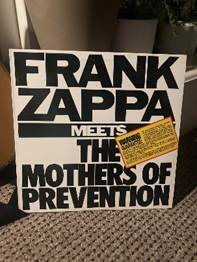
The title is a reference to the Parents Music Resource Center (PMRC)
Frank Zappa was spending increasing amounts of time battling the PMRC, an American committee set up with the aim of increasing parental control over the access of children to music deemed to have violent, drug-related, or sexual themes by labelling albums with Parental Advisory stickers. Frank Zappa’s view was that children should be allowed to make up their own minds as to what they want to listen.
This led to lots of time testifying at committee meetings and on tv. (There is a bizarre and riveting watch where Frank Zappa finds himself next to Donny Osmond, debating the subject. I think the host was expecting conflicting opinions, and to a certain extent they did have opposing views. However, Donny Osmond did object to Parental Advisory stickers because, he reasoned, his records wouldn’t have them on, therefore children wouldn’t buy his records as that would make them unhip. (I’m not kidding).
Anyway. What is on this record.
Another mixed bag. Recorded between 1981 and 1985, what we have is a mixture of bonza instruments, not so great songs, synclavier music and a sound collage.
Of Side One’ two songs, ‘We’re Turning Again’ (hippies and drugs are in good) is quite good and ‘Yo Cats’ not so good.
Instrumental, ‘Alien Oriface’, is the first appearance on record of a popular live piece, recorded in 1981.
It starts with a complex percussion and synth duet over a walking bass line and ska guitar and it’s as complex as it is enjoyable. It continues with a satisfying Frank Zappa guitar solo before percussion, synth and now guitar (Ed Mann, Tommy Mars and Steve Vai) conclude proceedings. It’s a good one and a late period Frank Zappa highlight.
As is second instrumental ‘What’s New In Baltimore’, which starts with an undulating and spiralling melody playing on both percussion and guitar before a big tune provides the big finish (later live versions would add lyrics over this ending – a big sing along with everyone asking “What’s new in Baltimore?’). It’s surprisingly enjoyable and welcome.
Side 2 is given over to synclavier pieces, the centre piece being Porn Wars, a sound collage featuring recording from PMRC hearings, including Tippa Gore, (the wife of (then) Senator Gore), who set up PMRC after she found her then 11-year-old daughter Karenna playing “Darling Nikki” by Prince. Oh dear.
It’s frightening to hear ‘American Law Makers’ trying to pass laws that would restrict what people can listen to based on their own prejudices. It even has a clip of Senator Gore addressing Frank Zappa at one of the hearings, claiming that he’s a fan of his music, whist at the same time trying to censor it.
It ends, bizzarly with a senitor thanking Frank Zappa for his testimony and calling the next witness John Denver! (John Denver was one of Frank Zappa’s few allies in the fight against the PMRC, something Frank Zappa found surprising and commented upon at the time. He couldn’t understand why the, supposedly, more enlightened artists like Bruce Springsteen and Bob Dylan would not speak up against censorship but John Denver would)
It might be Frank Zappa’s most political piece.
It’s worth noting that European versions of this record don’t have Porn Wars on it and it’s replaced by three other pieces
The record ends with Aerobics In Bondage, a pleasant synclavier piece that’s musically reminiscent of music Frank Zappa was writing in the late 60’s.
This is another of Frank Zappa’s later records that I’ve not played for years and I’m surprised by how good it is.
What does it sound like? Remember the party on day one of the Frank Zappa thing? Turns out the people at the party had every reason to be paranoid, the only different being that the finale to the evenings entertainment wasn’t a room full of percussion being tipped on their heads, instead Tippa Gore tipped sanitised stickers to gum people to the floor.
Day 42 of the never ever ending Frank Zappa thing. January 1986. Does Humour Belong in Music. Frank Zappa
Released alongside a VHS, these are live recordings from the American tour October to December 1984.
It was the first Frank Zappa album to be released on CD only (vinyl bootlegs do exist).
A mixture is live favourites and new pieces played by a stripped down line-up. No Ed Mann on percussion (for the first time since 1978), no Tommy Mars on keyboards (for the first time since 1977) and no Steve Via on guitar.
It’s another of Frank Zappa’s 80’s recordings I’ve not played in ages. To be honest the airbrushed lettering and not very promising title put me off.
The contents are not as troublesome as I first imagined and most of it concentrates on instrumental passages that highlight the fine ensemble playing of a band that had been rehearsed to within an inch of its life and then let loose.
Some pieces are familiar (‘Zoot Allures’ is played pretty straight), some have embellishments.
There is an updated and elaborated ‘Tinsel Town Rebellion’, with music references to acts Frank Zappa doesn’t like.
An updated ‘More Trouble Everyday’ gets in an MTV mention which actually dates it now.
‘Penguin in Bondage’ is bizzar and that’s fine, with an even more than usual ‘out there’ Frank Zappa guitar solo.
‘Hot plate Heaven at he Green Hotel’ is a new one and has an excellently catchy (and for Frank Zappa quite simple) saxophone riff that drives it along. It’s a song that attacks both Republicans and Democrats and the lie that is trickle down economics. Another long guitar solo occupied the middle section.
An excellent version of ‘What’s New in Baltimore’ adds lyrics this time and another extended guitar solos. It’s all very joyous.
This is followed by ‘Cock-Sucker’s Ball’ which does sound like a Frank Zappa song but is actually a cover of a song by the famous Doo-Wop band The Clovers.
The story goes that The Clovers wanted to record one of their own songs instead of the songs usually given to them to sing by their record company, Atlantic.
This was an unusual request but because the band were so successful their producer thought why not. He started recording and the band started to sing acapella.
The song was “Rotten Cocksuckers’ Ball.” and the lyrics meant that it didn’t get released at the time. It did appear on a bootleg in the 70’s and Frank Zappa, being a fan of both Doo-Wop and lyrics indented to shock, couldn’t resist recording his own version, just to annoy any Republicans in the audience. It segues into WPLJ, the Ray Dobard written Doo-Wop number that Frack Zappa recording with the Mothers of Invention back in 1970.
The longest track is a new instrumental called ‘Lets Move To Cleveland, a big, bold and brassy affair that makes way for a beautiful and accomplished piano solo by Allan Zavod (who is a very good jazz pianist as well as a composer), the new keyboard player for the 1984 tour (Tommy Mars left at the end of the 1982 tour). It even has a rare thing for Frank Zappa, a drum solos with electronic percussion, by Chad Wackerman.
It ends with another rendition of Whipping Post (with Frank Zappa’s son Dweezil on lead guitar.
What does it sound like? Ballsy, brassy band blast through bonkers back catalogue.
Day 43 of the continuing and ongoing Frank Zappa thing. November 1986. Jazz From Hell. Frank Zappa.
This is the last studio album by Frank Zappa. He would only release live recordings for the rest of his life. (I’ve just checked and that’s 12 double CD over the next 6 years! (The Torture Never Stops) Though there is an album he recorded but wasn’t released until after his death).
With hindsight we are entering the ‘endgame’ of Frank Zappa, whether he knew it or not at this stage is debatable. There would be some new material but a lot of his time would be focused on a possible presidential campaign (I kid you not) and more politically active pursuits and tv appearances to campaign against censorship in the arts.
I’ve contemplated what to listen to going forwards but think a truncated exploration of everything Frank Zappa released in his lifetime is the only way to go.
Anyway, again, the music.
All but one track is Frank Zappa and his synclavier.
First track ‘Night School’ is a straight forward piece of 80’s sounding soundtrack muzak that resembles a theme from a long buried pilot episode. It’s pleasant but forgettable.
‘The Beltway Bandits’ twinkles, burbles and clatters without really going anywhere. Stripped of the ebb and flow that live performers bring to such music it’s all a little cold. Percussively it’s pretty straight forward. Maybe not having real musicians to tease and taunt with complex arrangements was a stumbling block for Frank Zappa. Having to program and perform the parts himself he hits the ‘repeat’ icon too much. Maybe?
‘While You Were Art II’ is based on a transcription of Frank Zappa’s improvised guitar solo ‘While You Were Out’ from Shut Up and Play Your Guitar. It’s interesting but a bit pointless, an improvised guitar solo is impressive because it’s improvised. When it’s played note for note and quantized to hell (that should be the album’s real title) it’s less interesting.
‘Jazz From Hell’ does have the sonic vocabulary of a jazz band as snares and hi-hats (or rather, digital versions of them) perform skittishly behind clarinet squiggles, though it does become too regimented eventually.
‘G Spot Tornado’ was created as a piece of music that would be impossible for humans to play. Unfortunately (or fortunately) for Frank Zappa the Ensamble Modern would go and do just that in 1993. (Though, to be honest, it doesn’t sound any harder than some of the pieces he made his 80’s bands play live).
Damp Ankles is a slow swampy groove underscoring some fine melodic passages by woodwind sounding samples.
St. Etienne is a guitar solo by Frank Zappa taken from a live rendition of Drowning Witch in 1981 and is the only track to feature a band. (It’s a welcome bit or organics amongst the digital clatter and it’s also a relief when the humans turn up).
Final track ‘Massaggio Gallore’ sounds like a chase scene from Miami Vice.
It was fascinating at the time but now feels very dated. It’s all very mid range and lacking in bass; it’s bright, brittle and bitsy. (It would have made for fascinating gaming music).
That is not to say it isn’t without merit, it just hasn’t aged well and though compositional there are impressive elements present, they are just a bit buried in a molasses of midi.
What does it sound like? A rather sugary piece of rock with 1986 sonically running through it.
Day 44 of the ongoing saga of the never ever ever ending Frank Zappa thing. September 1987. London Symphony Orchestra Vol II. Frank Zappa.
Recorded at the same sessions as Volume I, so I’m guessing these were the cuts that didn’t make the grade first time around.
Frank Zappa, in his notes on the record, claimed he was waiting for technology to evolve enough for him to be able to fix the bad playing and wayward tunings that plagued these recordings. The technology didn’t arrive so he had to make extensive edits to hide such errors. He was also annoyed that reviewers criticised previous record Jazz From Hall for sounding sterile (*holds hand up there*) so thought we might like this more organic, human sounding effort with all the mistake we so obviously love so much. “I have done as much as possible to enhance this fine British ‘craftsmanship’ (at least 50 edits in 6:56), but, to no avail . . . the ‘human element’ remains intact”
Anyway. The music.
Side one is all about ‘Bogus Pomp’, an extended version of the ‘Orchestral Favourites’ track (which was also a reworked version of the “Sealed Tuna Sandwich” suite on 200 Motels.)
It’s all a bit lumpy. Frank Zappa describes it as a “parody of movie music cliches and mannerisms”. Which is what it sounds like. It misses the sparkle and inventiveness of previous orchestral works. Maybe the title sums it up perfectly.
‘Bob in Dacron’ is better and, again, shows the influence of Stravinsky. I really enjoy this piece and it makes perfect sense that Frank Zappa envisaged it as being music for a ballet (along with Sad Jane from Vol I)
The final track and another version is ‘Strictly Genteel’ (as first heard as the finale to 200 Motels and Orchestral Favourites.)
It’s slow and ponderous and the pissed up brass section sounds like…a pissed up brass section, and the whole thing fades off into the distance like drunks at closing time.
Overall it’s no where near as good as Vol I and I’m guessing it was released because Frank Zappa could release what he liked and he thought he might get a bit of cash back to offset the costs. No wonder he was pissed of with the performances. Maybe that’s another reason why he released it. A shaming exercise?
What does it sound like. An orchestra having a bad day after a bad pint.
Day 45 of the Frank Zappa thing. April 1988. Guitar. Frank Zappa.
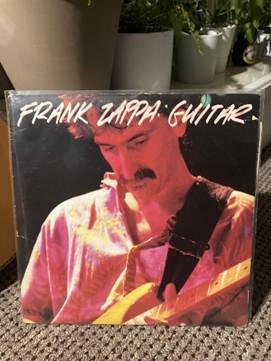
Another set of guitar solos recorded live. This time it’s only a double! (On vinyl that is. It was originally going to be another 3 LP set and the CD version has enough material for that. The double LP was a truncated version. From now on CD’s would be Frank Zappa’s preferred medium as they were cheaper to produce and you put a lot more music on it. It was the future. (Warning. He had started to reissue lots of earlier recordings on CD. Unfortunately he replaced the original drum tracks with re-recorded modern versions. A stupid idea.)
Recorded between 1979 and 1984 they follow the same format at Shut Up And Play Your Guitar where solos are given their own title, rather than referencing the music they are from. The exemptions being two tracks from Joe’s Garage Acts II & III, Watermelon in Easter Hay and Outside Now, because they were guitar solos to start with.
If you liked Shut Up and Play Your Guitar you’ll like this. If you don’t then it’s not for you. Some people must have like it as it was a number 82 smash in the UK album charts (his first to feature is the top 100 since Them or Us, 4 years earlier. It was a reasonable hit in Austria – no idea why).
One difference is that Frank Zappa was now mainly playing a Fender Stratocaster (with a whammy bar). (The Shut Up and Play Your Guitar recordings were from a time when he used a Gibson SG and then a Les Paul Custom …gear fans). He uses the whammy bar a lot get more abstract sounds.
I have to confess that, although I do enjoy and admire Frank Zappas guitar solos, right now they have become a part of the room and fall out of the speakers like aural dust, settling over the furniture. I also think they are starting to make me sneeze. I might be developing an allergy.
On a personal note….when I first moved to Wakefield this record would be a constant at many parties I found myself at. It must have fitted with the ‘ambience’….I remember lots of lava lamps and a craving for crisps. Anyway…….
Favourites? ‘That Ol’ G Minor Thing Again’ has an honest title and is a welcome uptempo number, and Steve Via joins in (generally a good thing). (Lots of previous guitar solos have been played over a typical Frank Zappa mid-pacer rhythm backing).
‘Sunrise Redeemer’ is a fast blast of notes over an excellent groove taken from a rendition of Let’s Move To Cleveland.
‘Orrin Hatch on Skis’ from a 1984 rendition of ‘Ride My Face to Chicago’ wins the best title on title award. (Orris Hatch was the longest serving republican senator in US history – fact fans)
‘Winos Do Not March’ is excellent and is from ‘Sharleena’ in 1984 (though I might had mentioned this will be surpassed by the version on You Can’t Do That On Stage Anymore vol 3
‘Watermelon in Easter Hay’ is always worth a listen and brings this collection to a satisfying conclusion.
What does it sound like. The party’s still going though you’ve tried to leave, honest, and now you wish that damn industrial vacuum cleaner would stop dancing around the caravan, do it’s job and hoover up all the infernal guitar dust. Anyone got a packet of fig rolls?
Day 46 of the never ending ending that is the final part of the very long (so long I’ve forgotten when we started) Frank Zappa thing. April 1988. You Can’t Do That On Stage Anymore (Sampler). Frank Zappa.
You Can’t Do That On Stage Anymore (YCDTOSA)was a series of 6 double CD sets compiling live recordings (with no overdubs) from across Frank Zappa’s career.
With a total time of over 13 hours of music this mammoth set was curated by Frank Zappa at the same time as touring from February to June with his ill fated 1988 band. (But that’s for another time)
This record was, as the name implies, a sampler of some moments from volumes 1 to 6 and was released to tempt fans to buy a CD player so they could hear all the music on offer.
Now, I have to confess that I’ve been listening to volumes 1 to 6 intermittently over the last few weeks and wondering if they should form part of this listening adventure.
I’ve been listening to them during the day in my studio whilst I’ve been doing other stuff and I have been having a blast; finding them funny, exhausting, poignant and challenging. (All the other listening and writing sessions have been happening at night, at home and with creature comforts).
He was half way through releasing these 6 volumes when he was diagnosed with prostate cancer.
Over the next three years, as well as the final three volumes of YCDTOSA, he released 2 double CD’s and 1 single CD of the 1988 tour plus 3 CDs of stuff from Mothers Of Invention, plus setting up the realise of a staggering amount of other material.
Oh, and his final record – Yellow Shark.
So I figured if he can do all that the least I should do is listen to it.
Coming soon – You Can’t Do That On Stage Volume 1
What does it sound like? I guess we’ll find out soon enough.
Day 47 of the never ending, seemed like a good idea at the time, Frank Zappa thing. May 1988. You Can’t Do That On Stage Vol 1. Frank Zappa
Live recordings spanning 1969 to 1984.
Highlights and lowlights throughout.
Oh no! Mark Volman and Howard Kaylan return (for a couple of tracks) and this time they are pretending to be a sofa whilst performing ‘Sofa’ (from 1971), that beloved song from One Size Fits All, in a very early version. Fascinating though inessential. Remarkably that lovely tune survives their onslaught.
It’s leaps from there to The Mammy Anthem (from Thingfish) and 1982 and rock guitar workouts etc.
A surprisingly faithful version of ‘You Didn’t Try to Call Me” ( from first LP Freak Out) is played by his 1980 (You Are What You Is) band.
A total of 40 musicians plays on these tracks (including 9 drummers).
Lots of on stage chatter between Frank Zappa and band members gives an indications of life on the road (‘Diseases of the Band’ is a rundown of ailments suffering by the Joe’s Garage band announced during a gig in London in 1979)
A medley of “Let’s Make the Water Turn Black/Harry, You’re a Beast/The Orange County Lumber Truck” by The Mothers of Invention in 1969 is a reminder that that band could play beautiful. This was recorded a few months before that band split up for good.
An excellent performance of ‘Big Swifty’ by the Roxy Band in 1973 nearly steals the show and is an excellent reminder of how great that band was. Listening to them for the first time in *checks notes* 28 days is a relief.
Having said that the highlight of CD1 is a 20 minute rendition of ‘Don’t Eat The Yellow Snow’ from Hammersmith Odeon in 1979 (by the Joe’s Garage Band). It includes ‘Don’t Eat the Yellow Snow’, ‘Nanook Rubs It’, ‘St. Alfonzo’s Pancake Breakfast’, and ‘Father O’Blivion’ plus ‘Rollo’.
This is the full version Frank Zappa intended to put on Apostrophe but ‘Rollo’ was omitted at the last minute. Here it is in all its glory (with Robert Plant style wailing, audience participation and poetry recitals).
It’s a delight to hear this line-up play through all the sections without breaking into a sweat (they might have but it doesn’t sound like it. Alfonzo’s Pancake Breakfast is astonishing )
CD 2. Hello 1969 and the Mothers play Plastic People/Louie Louie alongside a critique of the burgers available at the show and a music educational episode.
A long version of ‘The Torture Never Stops’ by the Sheik Yerbouti band is good.
There’s a stupidly fast version of ‘Zomby Wolf’ from 1982.
Unexpectedly there’s a 1969 band rendition of the song Sweet Leilani (written by Harry Owens in 1934) before they launch into a cracking version of Oh No.
And on it goes.
There’s ‘Deathless Horsie’ and ‘The Dangerous Kitchen’ from 1984, chunks of You Are What You Is and we end up, almost where we started at – ‘Sofa#2’ played as an excellent concert ending by the 1982 band.
These are exhausting listenings. But there you go. Lots to enjoy. Lots to skip.
What does it sound like? A cornucopia of musical crossroad for you to wander at your peril, also like biting blindfolded into a pizza designed by a child. You might get anchovies, you might get pineapple, you might get both.
Day 48 of the Frank Zappa thing. October 1988. You Can’t Do That On Stage Anymore Vol 2 (The Helsinki Concert). Frank Zappa.
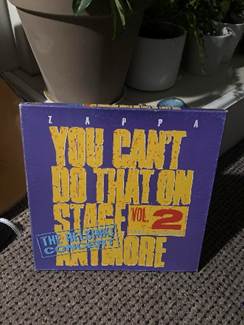
Unlike the rest of the YCDTONA series this features one line up from one year and one venue (though it’s taken from recordings from 2 consecutive nights, 22nd and 23rd September 1974 in Helsinki, it is sequenced like a complete concert).
Also, unlike the rest of the series, this was released on vinyl as a triple LP box set. So he must have liked it.
The band is a stripped down version of the Roxy LP band
They are worth naming.
* Frank Zappa – lead guitar, vocals
* Napoleon Murphy Brock – saxophone, flute, vocals
* George Duke – keyboards, vocals
* Ruth Underwood – percussion
* Tom Fowler – bass guitar
* Chester Thompson – drums
Lots of familiar materiel but played with the ease only a year on the road can achieve.
What’s on it?
‘Inca Roads’ has stupendous George Duke ‘Fender Rhodes,’ and synth solos.
‘RDNZL’ has percussion, keys and flute all playing the same tune at a ridiculous speed and is a great example of homophony, something that Frank Zappa would explore more in later music. (It’s worth highlighting Napoleon Murphy Brock at this point. He sang most of the material but was also an extraordinary saxophone and flute player when he wanted to be).
‘Village of the Sun’ is played twice a fast as the Roxy and Elsewhere version but still makes sense.
After a ridiculously complicated (yet effortlessly performed ) rendition of ‘Pygmy Twylyte’ (with funk guitar solo) the band settles down to improvising a recollection of recent events at their hotel (where their lighting director had been maced in the face by an overly zealous security guard the night before) on a track called ‘Room Service’. It’s the type of thing the band could drop in at a moments notice. (“Room Service? Can I have the fish with the eyes falling out?”)
It’s all wonderfully chaotic and tight at the same time.
‘Cheepnis’ (which I’ve written about previously) is bonkers fast and hats off to drummer Chester Thompson for keeping the tempo going whist still grooving. In the world of Frank Zappa drummers, Chester Thompson’s stint was short but impressive).
‘Approximate’ is one of the more extreme yet funny things that Frank Zappa did.
The band is given a piece of music where the rhythms is written down but the pitch isn’t, so when the band plays it they are rhythmically co-ordinated but harmonically not. After playing the ‘tune’ they then have to ‘sing’ it. Then they have to ‘dance’ it.
Ruth Underwood plays astonishing percussion throughout.
It’s gloriously silly and challenging. (There’s a good video on YouTube of the band doing this on live tv, something Frank Zappa is obviously pleased at getting away with ). Plus it has an excellent guitar solo.
‘Dupree’s Paradise’ was a live favourite and was later released as part of Boulez Conducts Zappa: The Perfect Stranger.
Here it takes centre stage with a 25 minute version. (Including a nod to Ricky Don’t Loose that Number by Steely Dan and Suzy Quattro cassettes – I’ve no idea why). Oh, and Frank Zappa delivers a monologue about security not happy that someone has stolen the hotel towels.
It then settles down to a series of solos with flute, bass (a standing ovation from me for Tom Fowler, an unassuming stage presence but a fluid and dexterous bass player), keys (where George Duke accompanies himself on Rhodes piano and clavinet followed by arp synth (the arp synth was an instrument George Duke wasn’t keen on. Frank Zappa bought him one and put it on top of George Duke’s Fender Rhodes piano. It sat there for a while until he tried it just to please Frank Zappa. They became firm friends), drums, (I’ve already sung the praises is Chester Thompson), percussion (the excellent Ruth Underwood) and a percussive version of Louie Louie (the song that appears at every Frank Zappa concert at some point).
Next we have a track called Satumaa (Finnish Tango). Satumaa is (apparently) a quintessentially Finnish tango (yes, I didn’t know that also) played at short notice as a request. The band is playing it from sheet music (so the house light go up) with Napoleon Murphy Brock trying his best to sing the Finnish lyrics.
It’s obviously ridiculous but the band negotiate it, much to the appreciation of the crowd.
Some familiar tunes in quick succession ‘T’Mershi Duween’, ‘The Dog Breath Varitions’, ‘Uncle Meat’ plus new tune ‘Building a Girl’ set everything up for the grand finale of ‘Montana’.
When announcing ‘Montana’ a member of the audience, rather bizzarly, shouts out a request for ‘Whipping Post’ (by the Allman Brothers). Why? No idea, but many years later Frank Zappa would eventually play Whipping Post, a very delayed request). However, Chester Thompson messes up the complex drum into (Frank Zappa – “it’s too fast for you?”) so Frank Zappa instructs the band to play it at (almost) half tempo. That’s a very hard thing for the band to do but they do it and it works.
The concert ends with a short version of Big Swifty and we are done.
It’s a glorious performance by a band having a ball and (possibly) my favourite Frank Zappa recording – (ok…equal top 5).
It must be a special recording for Frank Zappa not to overdub and mess about with it.
What does it sound like? How about, the greatest live recording by a jazz/funk/classical/garage/avant- guard band you’ve ever heard. Or…. A talented troop of technical excellence trip along a musical tightrope and don’t give a toss.
Day 49 of the stupid Frank Zappa thing. October 1988. Broadway the Hard Way. Frank Zappa.
A live album from the brief 1988 tour and the first of 3.
This one focuses on mostly original songs of a satirical and political nature.
For the 1988 tour he augmented his previous touring band
* Ike Willis – guitar,
* Robert Martin – keyboards, vocal
* Ed Mann – percussion
* Scott Thunes – bass
* Chad Wackerman – drums
with a 5 piece brass section and Mike Keneally on guitar.
This brass section, though highly skilled jazz musicians, often play tightly composed parts that echo the Warner Bros cartoon soundtracks of Carl William Stalling (who was a genius and wrote looney tunes and merrie Melodies music at a rate of one score a week between for 22 years)
Though to call it live is a bit of an anomaly as most of the tracks are edited together from many different concerts.
‘Jesus Thinks You’re a Jerk’ is spliced from 10 different concerts (I’ve mentioned before that I think Frank Zappa is a genius at editing. You can’t hear any interruption in the flow)
Political targets include Ronald Reagan, Jesse Jackson and many others.
It’s all very worthy but is it interesting?
Part fact, part conspiracy theory, it’s hard to tell. (Remember, Frank Zappa was considering an unlikely presidential campaign at the time. Was his lyrics genuine or campaign slogans.)
‘Dickies Such an Asshole’ was originally written in 1973 about Richard Nixon but is repurposed for Ronald Reagan.
These 9 tracks were bumped up to 17 in the CD reissue a year later with a guest appearance by ‘Mr Sting’ playing a Police song ‘Murder By Numbers’. (And although you might have guessed I’m a vinyl freak, the CD version is a lot more fun.)
It’s all very impressively played but this band would be better served over the other 2 released by this Ill fated line-up (not yet, but soon).
Sometimes political off the cuff thoughts don’t make the best listening, especially when filtered though needlessly complex arrangements. .
Oh…and ‘Promiscuous’ is a strangely contemporary rap sounding rant against surgeon general C. Everett Koop,
The record ends with a faithful rendition of ‘The Untouchables’ (by Nelson Riddle) whilst Ike Willis pontificates about the failings of contemporary figures.
What does it sound like. The least interesting of Frank Zappa’s 1988 band releases but if I’m pushed….. soap box speakers corner slot smugly inhabited by an insider highlighting everyone else’s failures whist saying ‘not me gov’. Sounds familiar?
Day 50!! of the Frank Zappa thing. November 1989. You Can’t Do That On Stage Anymore Vol 3. Frank Zappa
Another double CD of live recordings and another mixed bag.
Disc one of mostly from 1984 and opens with a version of ‘Sharleena’ that I briefly mention on day 38 “(There is an astonishing live version of this song on You Can’t Do That on Stage volume 3. One year after the studio version Dweezil joins his dad and band to play the guitar solo again, with his dad joining in a minute into it. It’s a joy!)” I’m starting to quote myself. That’s not a good thing and a sure sign I’ve been doing this waaaaay tooooo loooong.
It’s (at times) an enjoyable romp through some of Frank Zappa’s more salubrious songs. Impeccably played, dubiously intended and all that. Personally I think this line up is already well represented in Does Humour Belong In Music.
One interesting interlude is the inclusion of the riff from ‘Owner Of A Lonely Heart’ (by Yes) in the middle of ‘Bamboozled By Love’. No idea why.
There is, however, an excellent version of ‘Drowning Witch’ which is stitched together from 4 different concerts (one being from 1982 and is the only episode on this disc not by the 1984 band) because, despite the bands best efforts, they never quite got it right in one go. A pretty good effort though.
Highlights of disc 2
‘Dickies Such an Asshole ‘ is the encore for the Roxy and Elsewhere gigs.
‘Hands With a Hammer’ is a sensitive drum solo from Terry Bozzio before another rendition of ‘Zoot Allures’, this times it’s played quite slowly (most of it from a concert in 1976 but with the guitar solo from 1982).
A clutch of songs from You Are What You Is are impressive, as the album versions contained lots of complicated edits that this 1981 band learnt and performed seamlessly.
There’s a snappy 1984 rendition of ‘Cocaine Decisions’ that blends with a version by the 1982 band that includes the sound of teargas canisters going off at riot at the gig in Palermo, Sicily. This then becomes a slow blues jam as that band tries to remove the stinging effects of tear gas from their eyes. It was the last gig by the excellent 1982 band (with Ed Mann, Steve Vai and Tommy Mars, what a way to bow out).
Most interesting is a performance of ‘King Kong’ with most of it coming from 3 concerts in 1982 apart from a section in the middle, recorded at the ill fated Rainbow concert in 1971, just before Frank Zappa was thrown from the stage by the angry fan. (To my ears the 1971 band is a more enjoyable listening experience)
A 1984 pretty faithful version of ‘Cosmik Debris’ ends this listening session folks.
Overall – at times quite rewarding and at others – not as interesting as Frank Zappa thought it might be. The good bits are very good and I’m personally pleased I can hear them, the rest pass time. By now Frank Zappa was so obsessed with his own archive it’s hard to know where he’s going.
8 days to go. I’m counting.
What does it sound like. The party has run out of food but a surprise bag of Pick ‘n ‘mix keeps us going for a little while; it’s just mostly sugar but we’ve been here before and the occasional Fizzy Fish makes the dipping into the depths of the bag of bothersomeness occasionally rewarding.
Day 51 of the nearly over Frank Zappa thing. April 1991. The Best Band You’ve Never Heard In Your Life. Frank Zappa.
So….the 1988 tour. What did happen and what went wrong?
Previously Frank Zappa would often elect a band member to be a rehearsal leader, or ‘Klonemeister’, whilst he was busy with other business.
Bassist Arthur Barrows did this regularly in the early 80’s recalling that the band would rehearse 8 hours a day with him running the first 4 and Frank Zappa joining in for the remaining 4.
For the 1988 world tour Frank Zappa assembled his largest band since the Grand Wazzo. 11 band member in total including veteran horn players Bruce Fowler and Walt Fowler, from the Roxy band.
The elected ‘Klonemeister’ for this tour was 27 years old bassist Scott Thunes, a man with incredible a knowledge of Frank Zappa’s material, an intolerance for mistakes and absolutely no experience at directing musicians. This got the backs up of the older members of the band who were used to a more relaxed and fun approach.
After 4 months of rehearsals and 5 months of touring (February to June 1988) the band imploded, Frank Zappa cancelled the rest of the tour and sacked the band. He would never tour again.
A staggering 138 songs and pieces of music were learnt and performed during that brief tour. Quite a few covers were spontaneous ideas that the band had to learn in sound checks before the gig that night.
This double CD features many favourites along side unusual covers and popular melodies (I Left My Heart in San Francisco, the theme from The Godfather, When Irish Eyes are Smiling, theme from Bonanza are all used to make a point in the narrative that was that evening’s set list) and gives a fascinating overview of Frank Zappa’s career and as such this release can be a successful way in to his perplexing world.
The first CD, in particular, does this well. The second CD dives into unusual waters that culminates is a Ska rendition of Stairway To Heaven. Obviously.
Anyway….. let’s start at the beginning.
First number is an instrumental called ‘Heavy Duty Judy’, a set opening that will be familiar to anyone who attended the show at the NEC in Birmingham in April 1988.
After a few clicks of drum sticks a jaunty brass fanfares announces the band on stage, followed by a loud and raucous, fast and furious 5 minute Frank Zappa guitar solo. Nothing like hitting the ground running.
This of followed by a cheery “hello” from Frank Zappa. Which is nice.
This cuts to a cover of the song ‘Ring of Fire’ by June Carter and Merle Kilgore (as made popular by Johnny Cash). Why, you may ask? Well, the story that Frank Zappa tell at this concert in Germany is that earlier in the day he’d be introduced for the first time to Johnny Cash at the hotel. Johnny agreed to come to the concert and sing with the band. Unfortunately his wife became ill and he couldn’t make it. This left the band with a choice, as they’d learned how to play a reggae version of Ring Of Fire especially for Johnny that very afternoon. Should they not play it, or should they play it anyway? That was the question posed to the audience. They wanted to hear it so luckily we get to hear it too. How is it? Let’s just say that all the country musical twinkles and sprinkles are present, as is someone singing in their best country baritone whilst Frank Zappa comments in the banality of the lyrics “that’s right!…it’s the same verse again! It’s one way of learning English!” and adding “Ow! Ow! Ow!” after occasional ‘ring so fire’ lines. Frank Zappa finally says “Johnny will never know what he’s missed” It’s ridiculous, stupid, and it’s very funny.
Popular ‘Cosmik Debris’ is next, from the same concert, so there’s more mentions of ‘ring of fire’. After a bubbling Frank Zappa guitar solo it ends up with mentions of that immortal haemorrhoids cream ‘Anusol’, for those that haven’t quite got the new meaning of Ring Of Fire.
All the songs and piece flow together and the band, driven by drummer Chad Wakerman, swings like previous ones rarely did. I’m guessing Scott Thunes did a pretty good job after all.
1968’s ‘Who Needs The Peace Corps’ rubs shoulders with Zombie Wolf from 1973 (via some mocking of hippies and a comedic and wobbly ‘I Left My Heart in San Francisco’.
This version of ‘Zombie Wolf’ is a personal favourite. It’s extremely tightly performed in the complex sections, but is also loose and rubbery when Frank Zappa delivers a delightful solo. (The band appear to have put aside their more ‘rock’ elements that were present from 1982 to 1984).
Mind you, this CD features 8 songs from 1974 to 1976 (with 4 songs from 1975’s One Size Fits All) and it’s the heart of these recordings.
There a rendition is Bolero by Ravel, bizarrely. It’s rapturously received. It’s pretty faithful apart from the reggae rhythm. (Ravel was a master at arranging for orchestra, perhaps Frank Zappa wanted to test his own arranging chops by preseting this version with his band).
A lovely rendition of Zoot Allures contains another ‘low volume’ Frank Zappa guitar solo. After the opening Heavy Duty Judy’s guitar blast, Frank Zappa is preferring a highly processed (chorus and phaser, hey! it’s the 80’s. ) and non distorted guitar sound.
Next is a straightforward rendition of ‘Mr. Green Genes’ from 1969’s Uncle Meat which makes good use of the brass session.
As does ‘Florentine Pogen’ (and you know you’ve been doing this Frank Zappa thing too long when predicative text has absolutely no trouble with ‘Florentine Pogen’)
‘Andy’ (1975 – One Size Fits All) sounds huge and the brass section are loud and beautifully arranged, taking on many of the parts originally played by guitars and synths. It’s sounds like a natural end to CD 1 with Frank Zappa discovering his overdrive pedal again. The percussive tattoo also hints at a music climax. But no!
‘Inca Road’ is next (this is a greatest ‘non’ hits list). It’s excellent (with quick and unexpected Bee Gees references)
It might be worth noting that all the recordings on this CD were from the European leg of the tour (April to May) after a couple of months (and 37 concerts) on the road.
It ends with ‘Sofa’ (naturally) and I swear I’ve started to wake up hearing this tune. In this context it’s a perfect and relaxed celebration of all that’s gone on before.
(Date wise it’s worth mentioning that, by the time this CD was released, Frank Zappa has been diagnosed with advanced prostate cancer after years of urinary tract problems. He opted out of treatments since his options were limited by the late stage diagnosis. This, and the remaining releases during the next 3 years, should be heard in this context).
And I’m going to do CD 2 tomorrow. I didn’t intend to, I’m just enjoying myself too much and want to.
What does CD 1 sound like. A right old knees-up, with a pass the parcel where layers reveal irreverence or deftness or both.
Day 52 of the Frank Zappa thing. April 1991. The Best Band You’ve Never Heard In Your Life. Frank Zappa. (Part 2)
Because I got carried away with listening and writing about this recording I’ve done it in two parts.
The second CD starts with two bizarre cover versions performed (I believe) at a sound check on May 26th in Germany, ‘Purple Haze’ and ‘Sunshine Of Your Love’, with Ike Willis reprising his vocal mannerisms from Thing Fish.
This second CD is more episodic than the first one with many detours into political territories. Nothing wrong with that and it’s good that he used his platform to encourage people to vote and to call out the failings of the Reagan government as well as the strangle hold the religious far right had on federal opinions.
There’s also a big section of material given over to Frank Zappa’s delight at the fall of famed TV evangelist and puritanical zealot, Jimmy Swaggart. To cut a long story short….Jimmy Swaggart preached family values and the evils of sin, whilst frequenting prostitutes. When this came to light (at the start of the 1988 tour) Frank Zappa couldn’t resist taking the piss and reprised and repurposed ‘Lonesome Cowboy Jim’ (from 200 Motels) in honour of his downfall. It’s silly and funny and evens finds time to mock Lorrie Anderson’s ‘Oh Superman’ in the process.
But there is also exceptional playing by this band. ‘Let’s Move to Cleveland’ is a joy (and includes a quick burst of ‘When Irish Eyes are Smiling’ to celebrate St Patrick’s Day.
‘The Torture Never Stops’ is good also (and included more Jimmy Swaggart mockery.
As does ‘More Trouble Everyday’. When he remembers to shut up and play his guitar it’s great. (at this point Frank Zappa does that thing like a drunk in the bar; he doesn’t know when it stops being funny……)
Penguin in Bondage almost gets away with no Jimmy Swaggart references.
I think that’s why I don’t play this CD as much a the first. It’s was funny when I first heard it and took delight at a band and band leader changing sets and songs to fit a very topical moment, but many years later it’s like an okay joke you don’t want to hear again.
Then the band play ‘The Eric Dolphy Memorial Barbecue’ and all is forgiven. The brass section are given room to breathe and there’s an excellent trumpet solos from Walt Fowler. (There will be lots more of this on ‘Make A Jazz Noise Here’ in 1 days time).
This CD ends with that ska version of ‘Stairway to Heaven’. It’s silly and strangely uplifting and Frank Zappa is obviously taking the piss when he scores Jimmy Page’s guitar solo for the 5 piece brass section at the end. After the final notes of the arranged guitar solo end the brass section play snippet of ‘If You Go Down To The Wood Today’ and the mockery is complete. And I actually like it.
EDIT. *I think CD1 is near perfection and CD2 has perfect moments*
What does it sound like? A top jazz club with occasional bores propping up the bar.
Day 53 of the Frank Zappa thing. June 1991. Make A Jazz Noise Here. Frank Zappa.
Another double CD of live recordings from the 1988 tour.
These recordings focus mainly on instrumental selections from the 1988 repertoire.
CD 1
Opening Stink Foot still has the ghost of Jimmy Swaggart hanging over it from the previous recordings, but apart from that it’s a pretty faithful rendition.
Some tracks are great and some are not.
Second track ‘When Yuppies Go To Hell’ is a semi-improvised piece with samples played on Frank Zappa’s synclavier (which he brought on tour for this one and only time) alongside a full band performance. It is an attempt by Frank Zappa to merge recents musical experiments and it doesn’t work. It soon looses direction and pretty much falls apart altogether. It was only play once. That’s how successful it was. (Congratulations to anyone attending this gig in Brighton).
This then becomes ‘Fire and Chains’ another new one that starts off pretty aimlessly with a lazy jazz vamp with tortured vocals before a rhythmic guitar sample loop provides a rhythm and Frank Zappa remembers his guitar. Then it’s pretty good.
A collection of choice tunes from the 60’s follow – ‘Let’s Make the Water Turn Black’, ‘Harry You’re a Beast’, ‘The Orange County Lumber Truck’. ‘Oh No’ and ‘Theme from Lumpy Gravy’ are a gentle reminder of a time when Frank Zappa liked tunes, and sound great as a big band arrangement.
‘Eat That Question’ from Grand Wazoo is also pretty good.
‘Black Napkins’ suits the big band sound this lineup could produce and it all makes you wish he’d not included When Yuppies Go To Hell as we are now in prime Frank Zappa territory. It contains an excellent trumpet solo from Walt Fowler.
‘Big Swifty’ is also enjoyable and this band is playing beautifully. It’s now Bruce Fowler’s turn to shine with a trombone solo. (Though occasional sample noises by Frank and the inclusion of references to several classical music piece including ‘The 1812 Overture’ are perplexing) Solos from the rest of the horn section are all excellently done (though more Synclavier silliness spoil the party and not because I’m against technology but because they don’t add anything musical to the piece, they just come across as Frank Zappa playing with a new toy).
King Kong is, by now, a familiar tune over a reggae beat and an excuse for lots of variations and brass section solos. The opening few minutes are very exciting and I can almost not hear the, then, obliquitous Yamaha DX7 as the keyboard of choice by Bobby Martin (the only keyboard player on that tour – he also sang and played saxaphone on many previous tours but I think his sax playing was outranked and not needed on this occasion).
It does go on though, with synclavier interruptions that are now becoming annoying.
‘Star Wars Won’t Work’ is another example of live synclavier just becoming boring (and even thought I’m attempting to listen to every single second of music Frank Zappa released in his life time and seriously questioning that decision). (Nice guitar solo though).
I’m contemplating going this one over 2 days. Just because CDs let you out 74 minutes of music on them you really, really, don’t have to.
But…I’m pressing on because I want my life back
CD 2 starts with ‘The Black Page’ (New Age Version) and its wonderful. One of my favourite Frank Zappa pieces played slow (to start off with) before picking up the pace and it’s a joy. Frank Zappa remembers his guitar again so that’s another big plus.
A short ‘T’Mershi Duween’ then becomes ‘Dupree’s Paradise’. It’s a bit of a heavy version of what has, at times, been a beautiful tune but the succession of solos are good and get a few ‘jazz claps’.
And as much as I love the jazz tinged solos there is sense of relief in this room when ‘City of Tiny Lights’ starts, and is played straight (with Frank Zappa guitar solo, which is good but better is to come).
This is followed be a couple of minutes of Stravinsky and Bartok pieces (orchestrated by ostracised bassist Scott Tunes)
And on it goes.
Sinister Footwear 2nd Movement is another faithful rendition of an excellent Frank Zappa piece.
An out of place Stevie’s Spanking pops up but is a good excuse for some Frank Zappa rock guitar, which I quite like.
Alien Orifice it’s also nicely done and with excellent walking bass lines managing to underpin a series of solos.
Strangely for me though a highlight of this set is a version of ‘Crusin’ for Burgers’, that slight song from Uncle Meat.
The main reason is Frank Zappa’s ridiculous guitar solo played extremely fast whilst visiting scales only he would consider as acceptable (though Allan Holdsworth and John McLaughlin would know what’s going on).
It’s a whole barrel of fun which I’ve never got tired of over many many years.
It starts with slow stucatto chords and then bubbles into a joyous exploration of what a guitar can do whilst the rhythm section plays catch-up. It almost breaks down and collapses a few times but Frank Zappa continues, knowing that his band will rejoin eventually, with guitarist Mike Keneally doing an excellent job of tracking him. Just when you think it can’t get any more ridiculous it does just that. An unexpected gem.
Perhaps the record should end there. But it doesn’t. Advance Romance is ok and is Strictly Gentile, but they do take the sting out of the tail. I’m guessing Frank Zappa wanted a big band finish where he can credit the musicians, so fair enough.
And there we have it.
Another one where when it’s good it’s very very good……
Now imagine if Frank Zappa had taken the best bits from this one and added them to the best bits from The Best Band You’ve Never Heard In Your Life? That WOULD have been a fine record of the 1988 band in full swing. Instead we are left with the impression that there was a lot of unnecessary filler going on onstage at the time.
What does it sound like. Pristine playing over catalogue classic with technological belches.
Day 54 of the nearly ending Frank Zappa thing. June 1991. You Can’t Do That On Stage Vol 4. Frank Zappa.
One of the problems with CDs is the amount of music you can put in them.
This is another double CD of live material from 1969 to 1988 with over two hours of stuff to listen to.
CD 1 has lots of material from Frank Zappa’s 1984 tour (again). Lots of stuff we’ve heard before.
There is a version of ‘My Guitar Wants to Kill Your Mama’ (originally from Weasels Ripped My Flesh in 1970) which lacks the sting of the original.
A short blast through ‘Willie the Pimp’ (also from 1984) is pretty pointless as it is just a run through of the main vocal section plus a guitar solo that ends with the riff from ‘Montana’, which rather nicely morphs into –
‘Montana’ as played by the Roxy band (1973). Which is fine’ nothing startlingly new about it but I always like listening to that band. It then, rather annoyingly, is joined to a version from 1984. Deft and daft editing in equal measure.
Then there’s lots from Thing Fish, and there’s never a good reason for that.
‘Approximate’ played by the 1982 is impressive but also is pointless as it misses the context that made that piece great (i.e and explanation of the concept followed by the different versions). Here, it’s just the ‘tune’.
A quick ‘Love of my Life’ from 1980 is a pleasant bit of Doo-wop again (there will be more)
Another extract from ‘Let’s Move to Cleveland’ is notable for featuring a solo by Archie Shepp, a saxophone player who played a big part in developing avant-garde jazz in the 60s. It’s a lovely moment and I wish more jazz greats had joined Frank Zappa over the years. Frank Zappa obviously loved the form and his bands could always play beautifully in such settings. There’s a great piano solo from Allan Zavod, who I’ve mentioned before.
Rather wonderfully this then becomes ‘You Call That Music?’ from 1969, a Mothers of Invention exploration of avant-garde jazz. It’s also from a time when Frank Zappa was experimenting with silence in music. It’s delicate and delightful.
Which rather incongruously becomes a selection of solos from “Pound for a Brown’ in 1978, all prog clatter and synth wanderings from Tommy Mars.
Next up it’s time for the 1984 band to have a crack at ‘The Black Page’. It’s played stupidly fast to a ska beat. It’s impressive but all the beautiful expression, musical fluidity and rhythmic complexity is lost.
‘Filthy Habits’ from Sleep Dirt (1979), as played by the 1988 band, is a sinister blast of brass before and low and lascivious Frank Zappa guitar solo pops up. It’s good to hear this piece again.
Then there’s ‘The Torture Never Stops’ a song that originally appeared on 1976’s Zoot Allures but here it is played in 1975 at the same concert that Bongo Fury was recorded at and features Captain Beefheart on vocals. It’s almost unrecognisable from the recorded version and it’s ace.
And it’s a good place to end CD 1.
CD 2 and 13 of the 18 songs are from 1982 and 1984.
After a Frank Zappa anti corporate religious rant, we are into another version of ‘Stevie’s Spanking’ (this one is from 1982). It’s a vehicle for extended guitar solos from Frank Zappa and Steve Vai. There’s a typically fast and complex Stevie Vai solo before Frank Zappa responds with a lovely melodic downwards motif to start his own contribution.
There’s ’Outside Now’ (Joe’s Garage vol II & III) played by the 1984 band, ‘Disco Boy’ (Zoot Allures) played by the 1982 band (played very fast), ‘Teen-Age Wind’ (You Are What You Is) played by, again, the 1982 band. ‘Truck Driver Divorce’ (Them Or Us) played by the 1984 band…. It’s all become a bit “why are they playing that?” Perhaps that’s the theme for this CD. (Thought there is an excellent guitar solo from 1982 stitched on to the end of ‘Truck Driver Divorce’.
‘Florentine Pogen’ is an edit between two concerts, line-ups and years – 1974 and 1979 (but it’s mostly 1979) and it a bit laborious.
More interesting is ‘Tiny Sick Tears’ from 1969. In it Frank Zappa’s monologue replaces Jim Morrisons existential thoughts with a catalogue of more mundane everyday annoyances. It’s very funny.
‘Smell The Beard’ (which has a very subtle reference on Louie Louie) and ‘The Booger Man’ are previously unreleased songs from 1974 and are examples of that band making stuff up.
There’s Carolina Hard-Core Ecstasy (Bongo Fury) played in 1984.
“Cover versions of the following – Little Girl of Mine’ originally by the Cleftones (1961) “The Closer You Are; by The Channels (1956) ‘No, No Cherry’ by Little Caesar (1954) ‘Man From Utopia’ by Donald Woods and The Vel-Aires and a finale of ‘Mary Lou’ by Young Jessie (1954) are Doo-wop songs played straight by his 1984 and 1982 bands. It’s an unexpected and delightful ending to this release.
What does it sound like. Diminishing ratios between worthwhile and Ho hum and it sounds like I’m not in for a good evening with Vol 5 tomorrow.
Day 55 of the seemingly never ending Frank Zappa thing. July 1992. You Can’t Do That On Stage Anymore Vol 5. Frank Zappa.
Another double CD of live recordings. These stretch from 1965 to 1982. It’s nearly two and a half hours long!! FFS.
Luckily for us Frank Zappa has sensibly split these recording into two phases.
CD 1 is all Mothers of Invention between 1965 and 1969.
CD 2 is all from 1982
CD1 is by far the most interesting with many songs and pieces of music being unreleased gems.
Opening song ‘The Downtown Talent Scout’ features a very early Mothers lineup, and is from 1965, making it one of the earliest recordings by that band.
It’s about how mysterious guys would rush into bars in Sunset Boulevard and record (on 8mm film) all the ‘freaks’ they saw there, then rush out into a waiting cars.
It’s a great recording and Frank Zappa is actually singing and sounding remarkably like Mick Jagger (or maybe Mick Jagger, at that time, was trying to imitate an East Coast drawl). It sounds very much like Velvet Underground. Which is interesting.
Next is a selection from 1969. ‘Charles Ives’ is one of Frank Zappa’s almost Dadaist live happenings. This Mothers line up now included guitarist and singer Lowell George. Lowell George was a talented musician and arranger and this is the first of a series of recordings on this CD that feature him, which is great news for me as I’m a fan. Unfortunately Lowell George’s drug intake didn’t sit very well with Frank Zappa’s zero drugs policy so he left the band, with Frank Zappa’s blessing, and formed Little Feat (taking Mother’s bassist Roy Estrada with him).
Next is ‘Here Lies Love’ an R&B tune and it’s wonderful, with Lowell George’s vocals supported with perfectly realised brass accompaniment.
‘Piano/Drum Duet’ is just that. Ian Underwood (piano) and Arthur Dyer Tripp III (drums) play some familiar musical themes that would later appear in 200 Motels. It concluded with a short vocal yodelling.
‘Mozart Ballet – Pianist Sonata in Bb’ is also just that, played expertly on piano by Ian Underwood whilst various musicians (including Noel Redding) perform a short improvised ‘ballet’. This was from their second performance at the Royal Albert Hall before they were banned for life.
It’s all excellent stuff, gloriously silly yet extremely well executed and these are all reasons why I’ve really missed listening to this band.
25 tracks in total (including recorded snippets of dialogue and happenings – Frank Zappa had, at this point, acquired a portable recording devise for capturing just these kind of moments) provide and entertaining and enlightening listening experience.
‘Run Home Slow – Main Title Theme’ and ‘The Little March’ (here played live in 69) were originally written by Frank Zappa in 1959 for a cowboy movie written by his high school English teacher.
‘Return Of The Hunch-Back Duke’ is an excellent piece of music that would later form part of ‘Little House I Used To Live In’. This then becomes a menacing ‘Trouble Every Day’ (from Freak Out).
‘Proto-Minimalism’ is a short piece of complex yet repetitive, mainly percussive, instrumental music.
More recordings from the road and from photo shoots follow.
Some tracks are memorable and instant classics of the Mothers era (Baked Bean Boogie), others are pretty forgettable live improvisations which would probably be more fun to watch in the moment (Meow) – though on a different day I could have swapped those both around.
It’s almost a reserve list for Burnt Weeny Sandwich and Weasel Ripped My Flesh. Yes, that good. (In places – the CD curse means that there’s too much of it.
‘No Waiting for the Peanuts to Dissolve’ (1969) is for all of us that ever wanted to hear Lowell George and Frank Zappa play guitars together and it sounds like a live outtake from Hot Rats. (And the sound quality is excellent considering it’s from a 2 track tape).
‘Underground Freak-out Music’ is another good description of the music (with an excellent fuzz bass sole from Roy Estrada and I’m now longing for a live LP of just this band (1969 with Lowell George). There probably is one now as Frank Zappa’s estate has released another 60 (and counting) recordings from his extensive archives.
This CD ends with a version of ‘My Guitar Wants To Kill Your Mama’ that’s funky and slinky and very different to the one that ended up on Weasel Ripped my Flesh. It’s should have been a hit and on every Now That’s What I Can The 60’s compilation.
It’s a lot of fun and played with a wonderfully sense of adventure by a group of musicians happy to see where Frank Zappa’s conducting and interests would take them.
CD2 is not that.
It’s the 1982 band drilled to with an inch of its life, performing material that’s perfect at all times for fear that Frank Zappa would frown at a mistake and humiliate the musicians for getting it wrong.
Having said that, it’s still stunning in places but the band was battleing strange audience behaviour that lead to the concert in Palermo, Sicily ending in a riot (as recorded on YCDTOSA vol 3) and, documented on this CD the concert in Geneva being pulled short by Frank Zappa after too many objects being thrown on stage (this was becoming an increasing occurrence, in Milan this including used hypodermic needles).
As for the content, lots of concert favourites at the time – ‘What’s New in Baltimore’ (excellently played, obviously) ‘Easy Meat’, ‘Dancin’ Fool’, ‘RDNZL’, ‘City of Tiny Lights’, ‘Doreen’ pop up and it is a blast, it’s just that you have heard it all before?
It’s good to hear this talented band (Ray White, Steve Vai, Tommy Mars, Bobby Martin, Ed Mann, Scott Thunes and Chad Wackerman) play ‘Moggio’ (Man From Utopia) along side the ‘hits’. (The ‘hits’ – such as ‘Dancing Fool’ – are played ridiculously fast, as was usual on this tour. Perhaps he wanted to get them out of the way).
‘RDNZL’ is a good version with a lovely Frank Zappa guitar solo which, after the usual tight and tenacious musical bridge, we are treated to a delightful Tommy Mars piano and synth solos.
‘Advance Romance’ and ‘City of Tiny Lights’ benefit from the vocals of Ray White (he was an excellent addition to Frank Zappa’s bands and played on tours intermittently between 1976 and 1984).
‘Pound For A Brown On The Bus’ is beautifully precise AND fluid. Wonderful interplay between Ed Mann and Tommy Mars. Added scat vocals from Ray White work a treat and I find myself enjoying this CD way more than I thought I would. Damn.
Final track is a version of ‘Black Page’, always a test of any of Frank Zappa bands.
This time he makes his band perform it over a reggae beat. It’s an extremely difficult thing to do and a different version from the 1982 tour is available on YouTube and has to be watched to be believed. This version ends with another loud and full guitar solo from Frank Zappa. It’s a big and bold ending.
Then there’s a final warning from Frank Zappa for people to not throw anything on the stage. When they don’t agree, Frank Zappa asks for the house lights to go up and says ‘concerts over’.
This release benefits from the split CD idea (early years – later years) with both coming up smelling of freakish roses.
It’s been exciting to hear the early Mothers tracks and also to hear the 1982 band play beautifully. I just wish that they were 2 separate releases so I don’t have to spent so long on them. Selfish, I know.
What does it sound like. As you can tell by the notes….it sounds waaaaaay tooooo loooong!
Day 56 of the infernal eternal Frank Zappa thing. July 1992. You Can’t Do That On Stage Anymore Vol 6. Frank Zappa.
Yet another double CD of live material. Over 2 hours worth of music, recorded between 1970 and 1988. I mean…come on and give me a break!
This is also split, with different themes on each CD
CD 1 has a sexual theme running through it. Thanks for that.
CD 2 features lots of music recorded at Frank Zappa’s Halloween concerts that he did at the Palladium in New York along side other stuff.
Here goes….
CD starts with ‘The M.O.I. Anti-Smut Loyalty Oath’ from 1970 and hello again to Mark Volman and Howard Kaylan. It’s basically Frank Zappa and band publicly declaring, at the promoters request, that they promise to not do anything too smutty, much to the hilarity of both band and audience. (For context, Jim Morrison had just been arrested for exposing himself so promoters got very nervous).
‘The Poodle Lecture’ from 1977 is basically the band playing Stink Foot whilst Frank Zappa tells a slightly risqué story. It’s not terribly interesting.
‘Dirty Love’ from 1979 is way too fast.
‘Magic Fingers’ from 200 Motels is played by the 1980 band way too fast, again. (There’s another theme arriving here). It contains this record’s except of Louie Louie.
There are not too many highlight but quite a few lowlights
‘Honey, Don’t You Want a Man Like Me?’ is from the 1988 tour and just sounds weird and lumpy. Oddly, the brass stabs and not played by the brass section but sound more like Bobby Martin on a DX7. Nasty.
‘Father O’Blivion’ (from 1972) is unrecognisable from Don’t Eat The Yellow Snow and it’s awful.
‘Is That Guy Kidding or What’ is just Frank Zappa ridiculing Peter Frampton and his latest album ‘I’m In You’ for its lame double entendre title. His point being – Peter Frampton can get away with it because he is pretty and Frank Zappa probably couldn’t get away with it because he’s ugly. Possibly.
22 track in total on CD1 and there’s very little to recommend it. Lots of tracks are Frank Zappa monologues on a variety of subjects related to sex that he thinks are funny. They might have been at the time. Who knows.
‘Dinah-Moe Humm’ from 1984 is played way too fast. Obviously.
‘Camarillo Brillo’ (also from 1984) is played way too fast and then way too slow. And is awful also.
This CD ends with ‘Muffin Man’ (also from 1984). It’s initially played with a bad reggae feel but then takes on its more familiar form with, what I think has been, the first guitar solo of this set.
It’s as if Frank Zappa realised how bad this set is and wanted to end on a bit of a high. Then it fades out. Oh dear.
Congratulation! You’re just read about the worst set of recordings Frank Zappa has put out so far! Luckily you didn’t have to listen to it.
CD 2 – after a quick hello the 1984 band launch into ‘The Illinois Enema Bandit’ which doesn’t add anything new to the original but is okay.
‘Thirteen’ (from 1978) however, is a new piece and is excellent. It starts with Frank Zappa introducing guest L Shankar on electric violin and then introducing the audience to this pieces unusual time signature which is subdivided into 5/8 and 4/4 (or 13/8). The violin solo is lovely and Shankar is able to navigate the complex rhythm with ease.
It’s a real treat.
‘Lobster Girl’ is a Patrick O’Hearn and Vinnie Colaiuta bass and drum duet for 1978.
‘Black Napkins’ is from the same concerts that produced the album Zappa in New York and features an impressive saxophone solo from Michael Brecker, so it’s definitely worth investigating.
So far so good ….
‘We’re Turning Again’, played by the 1988 band is a surprise as it was a so so song from F.Z. meets The Mothers of Prevention, but here Frank Zappa’s sarcastic vocal delivery is tiresome despite the spirited band performance.
‘Alien Orifice’ from 1981 is a straightforward rendition of this complicated piece with Ed Mann, Tommy Mars and Steve Vai doing their unison playing thing.
‘Catholic Girls’ and ‘Crew Slut’ prove that the 1988 band had to play dumb music when asked.
There’s ‘Tryin’ to Grow a Chin’ from 1977 with the Sheik Yerbouti band, an unexpected ‘Take Your Clothes Off When You Dance’ played in 1978 (which sounds very sweet) and features a violin solo from Shankar.
‘Lisa’s Life Story’ is an improvised unique recording featuring vocalist Lisa Popeil
‘Lonesome Cowboy Nando’ is a ‘version’ of Lonesome Cowboy Burt stitched together from performances in 1988 and 1971. (Which is basically included to show off Frank Zappa’s new digital editing tool called Sonic Solutions) Its a bit of Frank Zappa vaudeville.
The big finished (which is, by now, expected) is provided by ‘200 Motels Finale’ from 1971 then ‘Strictly Genteel’ from 1981, though it’s less of a big finish and more of a limping over the finishing line. If this all sounds like I’m being too harsh that maybe because I’ve been, at times, too lenient.
CD2 started off well but it sounds like Frank Zappa ran out of ideas. This was the last of the YCDTOSA series and you get the feeling of a vault clearing exercise by an ailing Frank Zappa.
So to briefly sum up – 5 or 6 decent tracks out of 37.
If I’m being realistic (with vol 2 being put to one side as I love it) this series could probably be reduced from 10 CDs to 2 if you only include the interesting bits.
What does it sound like. It sounds like a Frank Zappa fan’s worst nightmare, where they realise they might be wrong and all the people who say he’s just a juvenile bore backed by over complicated music, might be right. Ouch.
Day 57 of the Frank Zappa thing. October 1992. Playground Psychotics. Frank Zappa/The Mothers of Invention.
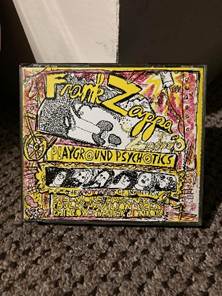
Oh boy. Another double CD of live material. This one features my least favourite band line up due to the annoying Mark Volman and Howard Kaylan. Oh lucky me.
There are 57 tracks on these 2 CDs! And a running length of over 2 hours. The good news is that a lot of the track are very short. The bad news is that a lot of the tracks are field recordings of the band on the road. So we get not very funny encounters with publicists and assorted management alongside typical chatter on tour buses and backstage. So that’s basically Mark Volman and Howard Kaylan trying to be funny and swearing a lot.
Frank Zappa somehow thought the public would be interested.
There are some band performances but not a lot. And most of it is not that memorable.
However there is something of interest on CD 1.
6th June 1971 at the Fillmore East in New York John Lennon and Yoko Ono asked to joint the Mothers on stage. Frank Zappa thought ‘why not’ and informed John Lennon that he was recording the concert for a possible live album (which became June 1971 – Fillmore East) and that he’d make available any material they recorded together as part of that concert.
Much to the audiences delight John Lennon and Yoko One made a surprise appearance performing 4 songs with the Mothers – Well (written by Walter Ward and first released by the Olympics in 1958), a version of King Kong with John Lennon and Yoko One shouting over it, ‘Scumbag’ (an original improvised piece) and ‘Au’ (another spontaneous eruption of sounds).
Later, Frank Zappa handed over a copy of the tapes with the agreement that they could both released it in some form if they wish – with appropriate credits of course.
Much to Frank Zappa’s annoyance these recordings (slightly altered to remove the vocals of Mark and Karl – which I would normally think is a good thing -) were released by John Lennon in June 1972 as part of his record Sometime in New York.
However he removed any songwriting credits for Frank Zappa on two of the three songs (he did credit Walter Ward). He also legally blocked Frank Zappa from releasing these recordings himself.
All this annoyed Frank Zappa, especially with King King, a piece of music he wrote which John Lennon renamed ‘Jam Rag’ on his record and gave sole credit (and publishing rights) to himself and Yoko One, even though you can clearly hear the main theme from ‘King Kong’ at the start.
Not only that – he took the artwork from Frank Zappa’s June 1971 – Fillmore East, scrawled his own credits in red pen over the top and printed that as the artwork for the inner sleeve of his record. Classy guy.
Frank Zappa finally got the rights back and could release these recordings in their original form. For the record –
Sometime in New York –
‘Well’ (Baby Please Don’t Go)” (Walter Ward)
‘Jamrag’ (John Lennon, Yoko Ono)
’Scumbag’ (Lennon, Ono, Frank Zappa) – 4:27
’Aü’ – 8:04 (John Lennon, Yoko Ono)
Playground Psychotics –
‘Well’ (Walter Ward)
‘Say Please’ (Lennon, Ono, Zappa)
‘Aaawk’ (Lennon, Ono, Zappa)
‘Scumbag’ (Lennon, Ono, Kaylan, Zappa)
‘A Small Eternity with Yoko Ono’ (Lennon, Ono)
(‘Say Please’ and ‘Awk’ are the same as ‘Jamrag’ (minus the main theme from King King (for some reason)) and ‘Au’ has been rechristened by Frank Zappa, rather wonderfully, as ‘A Small Eternity with Yoko Ono’ as its basically John Lennon on feedback and Yoko Ono on wailing for a good 6 minutes after the concert has actually finished and the band have left the stage. (A small eternity indeed).
CD 2 is another 30 minutes of on the road hijinks that don’t need to be listed to once, never mind again, plus a 30 minute rendition of ‘Billy The Mountain’. This is slightly longer than the version on Another Band From LA as that version had to be edited down to fit on one side of vinyl. As we’ve now discovered you can dump a whole load more onto CD. There are a few other tunes that might be great except for the vocal shenanigans of Mark Volman and Howard Kaylan.
Maybe the whole package is designed to get his own back on John Lennon by releasing those recordings as mere filler in the middle of an aural documentary of juvenilia.
What does it sound like? A long and painful eternity with Kaylan and Volman and Ono
Day 58 of the Frank Zappa thing. March 1993. Ahead of Their Time. The Mothers of Invention.
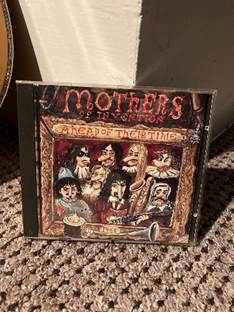
Another live CD. This one is a recording of a concert by The Mothers of Invention at the Royal Festival Hall in October 1968 and features the line up that included –
* Ian Underwood – alto saxophone, piano
* Bunk Gardner – tenor saxophone, clarinet
* Euclid James “Motorhead” Sherwood – baritone saxophone, tambourine
* Don Preston – electric piano, odd noises (homemade oscillation boxes)
* Roy Estrada – bass guitar, vocals
* Jimmy Carl Black – drums, vocals
* Arthur Dyer Tripp III – drums, percussion
– playing alongside member of the BBC Symphony Orchestra (14 of them, to be precise)
It’s just over an hour long! Hurrah!
The first part of the show is a one off performance of a play called ‘Progress’. Frank Zappa narrates whilst members of The Mothers of Invention act out the narrative. It’s lost a bit in the poor sound quality, and with out the accompanying visual, but it sounds like everyone was having a good time. (If you are brave there is some good footage on YouTune, just look up Frank Zappa Royal Festival Hall 1968 https://youtu.be/DK2sjthnpKM?si=g2d8fGKdD89J3x4s)
Musically it features a series of chamber piece Frank Zappa had been writing at the time and this play was a good opportunity to get them recorded. Musically these pieces point the way forward to 200 Motels.
It’s silly but in a lighthearted way and after the torturous recent listenings it’s a welcome reminder of how inventive this version of the Mothers could be, how good a pianist Ian Underwood could be and how nothing seemed to phase Frank Zappa. Of course he could hire the Royal Festival Hall and members of a symphony orchestra to play his compositions whilst orchestrating his band through a vague scenario to a full house. This, you have to remember, was a mere 2 years after his debut LP.
The second half of the concert is The Mothers of Invention playing through a selection of some of their better knows pieces from their previous records including ‘King Kong’, ‘Help, I’m a Rock’, ‘Transylvania Boogie’, Pound for a Brown’, ‘Sleeping in a Jar’, ‘Let’s Make the Water Turn Black’, Harry, You’re a Beast’, ‘The Orange County Lumber Truck’ ‘Oh No’.
Lots of these songs have featured over the previous 12 days of live listenings (from day 46 until now’, stupid Tony), usually in an oddly truncated fashion or with some ‘ironic’ twist. Here we can listen to them played, as they were originally intended, by a skilled but not too drilled band of musicians.
Okay, so the sound quality is not great (though way better than Frank Zappa thought and a hell of a lot better than many studio records I have from 1968 by a succession of bands), it’s still great fun, and although it’s called Ahead of Their Time it’s definitely OF it’s time. And that’s a very good thing.
What does it sound like. The party finally realising it can be rebellious, irreverent, bright eyed and bushy tailed, thumbing its nose at the establishment whilst using it’s hallowed halls to do so.
The Mothers of Invention epilogue
* Ian Underwood – alto saxophone, piano – still active and much in demand as a synth programmer and soloist for the film industry. Credits include Blade Runner, Aliens and Karate Kid
* Bunk Gardner – tenor saxophone, clarinet – still tours with Don Preston occasionally. He’s 90.
* Euclid James “Motorhead” Sherwood – baritone saxophone, tambourine RIP
* Don Preston – electric piano, odd noises (homemade oscillation boxes) – still gigs and tours with Bunk Gardner
* Roy Estrada – bass guitar, vocals – in jail until at least 2037
* Jimmy Carl Black – drums, vocals – RiP
* Arthur Dyer Tripp III – drums, percussion – retired from music and became a chiropractor
Day 59 of the ending Frank Zappa thing. November 1993. Yellow Shark. Frank Zappa and Ensemble Modern.
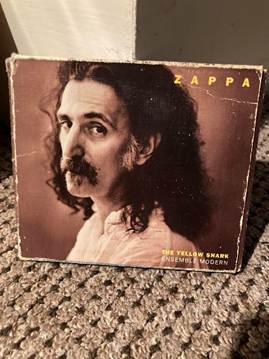
I do sometimes wished I’d just quoted Q Magazine from the 90’s when it did a comprehensive review of Frank Zappa’s back catalogue. The summary was ‘Sometimes brilliant, sometimes groundbreaking, sometimes crap’’. It would have saved a lot of time.
(61 hours 41 minutes and 20 seconds of time to be precise).
Anyway, here we are.
A live CD. Yes, another one but this one is a little different.
In 1991 Frank Zappa was chosen as one of 4 composers to feature in the 1992 Frankfurt Festival, along with John Cage, Karlheinz Stockhausen and Alexander Knaifel (Cage and Stockhausen are two of the musical giants of the 20th Century so this was a great honour).
European orchestras and composers greatly admired Frank Zappa’s music and it is ironic that, although at times Frank Zappa appeared to be dismissive of European culture, it embraced his orchestral works far more eagerly than the USA.
The Yellow Shark features recordings from 7 concerts in Frankfurt, Berlin and Vienna between 17th and 28th September 1992.
Frank Zappa personally arranged the musical program and adapted existing pieces for the unique arrangements of instruments at the disposal of Ensemble Modern. (Ensemble Modern is an international ensemble, based in Frankfurt, dedicated to playing contemporary classical music).
They approached Frank Zappa asking if they could play his music and flew to his rehearsal studio in
Low Angeles to rehearse. Often arriving 4 hours early each day so they could learn his music they greatly impressed Frank Zappa, who previously had a difficult relationship with classically trained musicians.
They even asked for scores of Frank Zappa pieces that were thought of as too difficult for humans to play (such as The Girl In The Magnesium Dress).
Though very ill, Frank Zappa supervised the technical requirements needed to record the performances to his exacting standards. This involved some of the most complicated microphone placements and monitoring requirements yet used to record a classical ensemble.
He also managed to attend the first 2 concerts but ill health meant he couldn’t attend any more. He relinquished the conducting baton to the ensemble’s regular conductor Peter Rundel. (Though there are clips on YouTube of him conducting G spot Tornado with frantic movement performance by a very energetic duo)
The result? Frank Zappa would describe it as one of the most fulfilling projects of his career, and as the best representation of his orchestral works.
Rapturous applause greeted the conclusion of each piece.
Tom Waites described it rather wonderfully. “The ensemble is awe-inspiring. It is a rich pageant of texture in colour. It’s the clarity of his perfect madness, and mastery. Frank governs with Elmore James on his left and Stravinsky on his right. Frank reigns and rules with the strangest tools.”
So, to the music.
19 pieces of old and new music performed with precision, warmth and wit.
The first couple of pieces, ‘Dog Breath Variations’ and ‘Uncle Meat’ are well know from Frank Zappa’s 60’s output. They are beautifully performed and set the tone for the concert.
Many pieces have an ecological theme.
‘Outrage at Valdez’ was originally composed for a documentary about the Exxon Valdez oil spill in Alaska.
‘Times Beach’ was a commission by the Aspen Wind Quartet in 1985 and concerns the town of Times Beach in Missouri, which is now a ghost town after dioxin contamination caused the immediate evacuation of the entire population.
‘The Girl In The Magnesium Dress’ was originally composed on Synclavier. The Ensemble Modern wanted to have a crack at this seemingly impossible piece. And have a crack they do!
It’s a beautiful twinkling of complex tones and rhythms that’s enchanting and very special.
‘Be Bop Tango’ first appeared on 1973’s Roxy and Elsewhere. Here it’s expanded to take advantage of the range of instruments available to Frank Zappa.
‘Ruth is Sleeping’ is another piece that was composed on the synclavier. It’s gets its name from Ruth Underwood because sometimes, during rehearsals of the 1973 band, she would curl up and sleep under her marimba whilst Frank Zappa gave lengthy instructions to his band. Here it is played as a piano duet and is extremely complex. (He had originally scored it as a solo piano piece that even Frank Zappa had to admit was very, very, very difficult. There is a version on YouTube of it being played by Michael Kieran Harvey in 1997, if you want to see how it can be done)
The climax to ‘Pentagon Afternoon’ involved members of the Ensemble Modern shooting the string quintet with toy ray guns, who then had to slump on their sides as if dead. (The concerts features many such performative sections).
‘None of the Above’ was originally commissioned by the famed Kronos Quartet and is all itchy and scratchy ( and would fit those cartoon characters well).
‘Welcome to the United States’ is a vocal recital of the inane questions and instructions on the US custom card, to musical backing.
‘A Pound for a Brown on the Bus’ is as light and delicate as the original version on Uncle Meat, and before the 80’s band turned it into a jazz workout. (If you are wondering where the title came from it’s based on a bet from the Mothers of Invention’s first trip to Europe. When they got to England one member of the band bet another member of the band they wouldn’t ’brown out’ on the bus before they got to London. So now you know.
It concludes with ‘G-Spot Tornado’, another ‘impossible’ piece performed to perfection. At the concerts I’m was accompanied by a frantic movement piece performed by Donald Weikert and Louise LeCavalier.
There’s more pieces than I have described and each is worthy of careful listening.
It ends with enthusiastic applause and a standing ovation, and in the film footage there is a close up of Frank Zappa with what might be tears.
Frank Zappa finally found the musicians to play his music just how he wonted it to be heard.
Overall, for those that think Frank Zappa’s music lacks emotion there is a surprising feeling of sadness hanging over the collection (which might be unsurprising give the terminal state of Frank Zappa’s health.
It is an astonishingly emotional listen both because of the music and where we are in the composer’s life.
The cover photo (in sepia) shows a slightly dishevelled Frank Zappa, trademark moustache grown out slightly with long, greying hair, and the appearance of having just returned from some Wild West frontier expedition, seen what people have done to the country, and returned home dejected.
It is the last recording released during Frank Zappa’s lifetime.
This was released in November 1993 and in the following month Frank Zappa died.
What does it sound like ? It sounds as wide screen as America and just as twitchy, paranoid and melancholy; the music of a metropolis that’s mournful, regretful and done.

 Tony Wade